Everyone is obsessed with body fat. The fitness industry built an empire on it. Your bathroom scale reinforces it every morning. Your doctor mentions it at every annual checkup. But here’s what the research increasingly shows: body fat percentage is one of the weakest predictors of how long and how well you’ll live.
There are three biomarkers that predict longevity with far greater accuracy. Chances are nobody has ever tested you for them.
The Wrong Number We’re All Chasing
Walk into any gym, open any fitness app, or sit down with most personal trainers and the conversation eventually lands on the same metric: body composition. Body fat percentage. BMI. The number on the scale.
These metrics are not useless. Severe obesity is genuinely associated with increased mortality risk. But as primary indicators of longevity and healthspan, they are remarkably poor predictors compared to what the science actually points toward.
Here is why body fat misleads us.
Body fat is a static snapshot. It tells you what you look like at a moment in time. It says nothing about how your cardiovascular system functions under stress. It says nothing about your neuromuscular capacity to prevent falls and maintain independence at 75. It says nothing about how efficiently your autonomic nervous system recovers from daily demands. It says nothing about your metabolic flexibility, your inflammatory load, or your mitochondrial density.
Two people can have identical body fat percentages and face dramatically different longevity trajectories based on these deeper physiological realities. The lean but sedentary office worker with poor cardiovascular fitness, declining muscle mass, and a chronically dysregulated nervous system is not in better health than their slightly heavier counterpart who trains consistently, moves well, and recovers efficiently.
Body fat is the metric we chose because it’s easy to measure. Not because it’s the most meaningful.
The three biomarkers that follow are harder to measure. They require more than a scale or a tape measure. But they are the ones that the most rigorous longevity research consistently identifies as the strongest predictors of both lifespan and healthspan: the quantity of years you live and the quality of life within those years.
Biomarker One: VO2 Max
What It Is
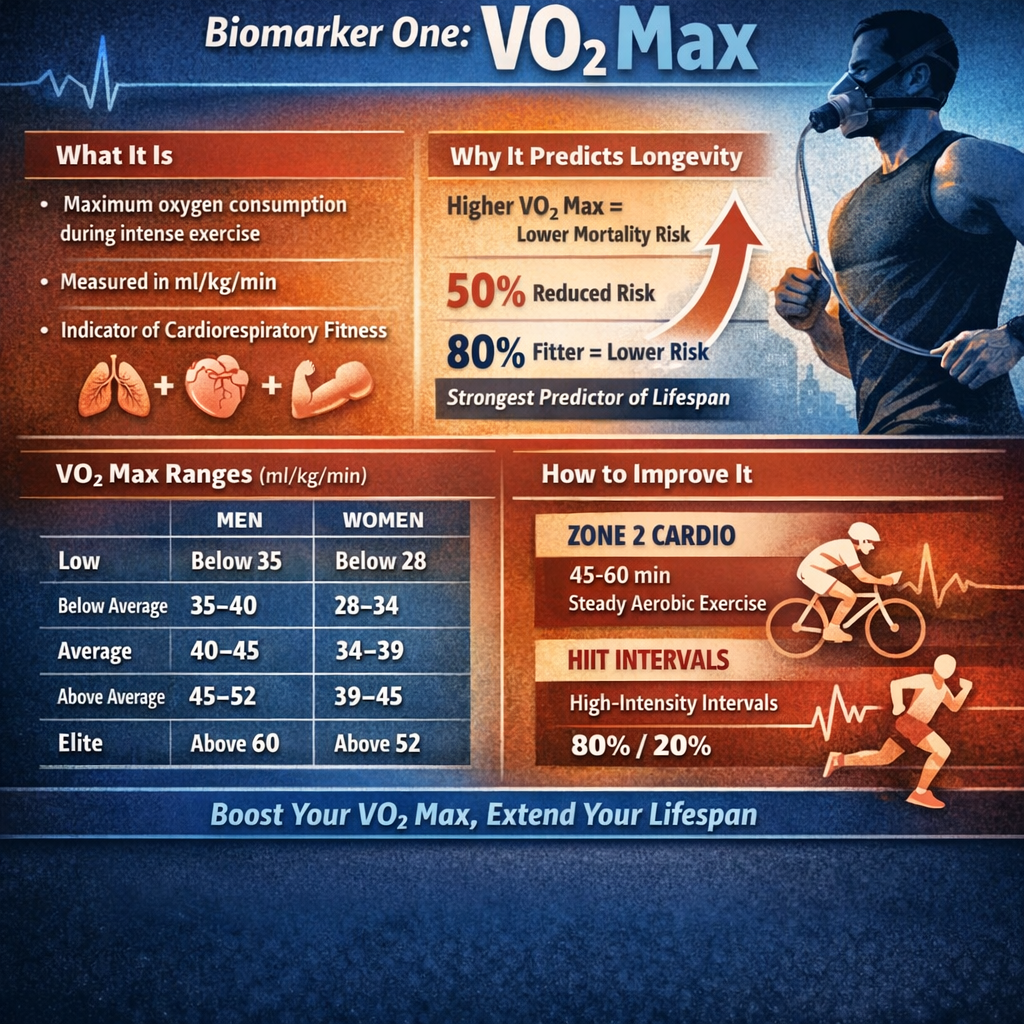
VO2 max is the maximum rate at which your body can consume oxygen during intense exercise. It is expressed in milliliters of oxygen per kilogram of bodyweight per minute (ml/kg/min) and is widely regarded as the gold standard measure of cardiorespiratory fitness.
In plain language, VO2 max measures how powerful your cardiovascular engine is. How efficiently your heart, lungs, and muscles work together to deliver and utilize oxygen during physical stress.
Why It Predicts Longevity
The research on VO2 max and mortality is some of the most compelling in all of longevity science.
A landmark study published in JAMA Network Open followed over 122,000 patients over a decade and found that cardiorespiratory fitness, measured by VO2 max, was the single strongest predictor of all-cause mortality. Stronger than smoking status. Stronger than hypertension. Stronger than diabetes. Stronger than body fat.
The findings were striking in their specificity. Moving from the lowest fitness category to the next level reduced mortality risk by approximately 50%. Moving from moderate to high fitness reduced it by a further 30%. And there was no upper ceiling observed: the fittest individuals in the study had the lowest mortality risk, with no point of diminishing returns.
To put that in context: the mortality risk reduction from improving VO2 max from low to elite is larger than the risk reduction from quitting smoking.
Peter Attia, one of the most rigorous thinkers in longevity medicine, has referred to VO2 max as “the most powerful marker we have” for predicting long-term health outcomes. His clinical work consistently prioritizes VO2 max improvement above almost every other intervention.
What the Numbers Mean
VO2 max declines with age at roughly 1% per year after 25 if you do nothing to arrest it. By 75, a sedentary person may have lost 40 to 50% of their peak cardiorespiratory capacity, which is the physiological equivalent of having a severely damaged engine trying to power the same vehicle.
Rough reference ranges for middle-aged adults:
| Category | Men (ml/kg/min) | Women (ml/kg/min) |
|---|---|---|
| Low | Below 35 | Below 28 |
| Below Average | 35–40 | 28–34 |
| Average | 40–45 | 34–39 |
| Above Average | 45–52 | 39–45 |
| High | 52–60 | 45–52 |
| Elite | Above 60 | Above 52 |
For longevity purposes, the research suggests that being in the top two quartiles of VO2 max for your age group is where the significant mortality risk reduction occurs.
How to Improve It
The most effective training stimulus for VO2 max improvement is a combination of Zone 2 cardio and high-intensity interval training (HIIT).
Zone 2 cardio, sustained aerobic exercise at a conversational pace for 45 to 60 minutes, builds the mitochondrial density and fat oxidation capacity that forms the aerobic base. Think of it as expanding the size of your engine.
High-intensity intervals, short efforts at 90 to 100% of maximum heart rate with recovery periods, push the ceiling of what that engine can do. Think of it as increasing the engine’s peak output.
The combination of both, roughly 80% Zone 2 and 20% high intensity, produces the most consistent VO2 max improvements across all age groups. And crucially, significant improvements are achievable at any age. Studies have demonstrated meaningful VO2 max gains in participants in their 70s and 80s with consistent training.
Biomarker Two: Grip Strength
What It Is
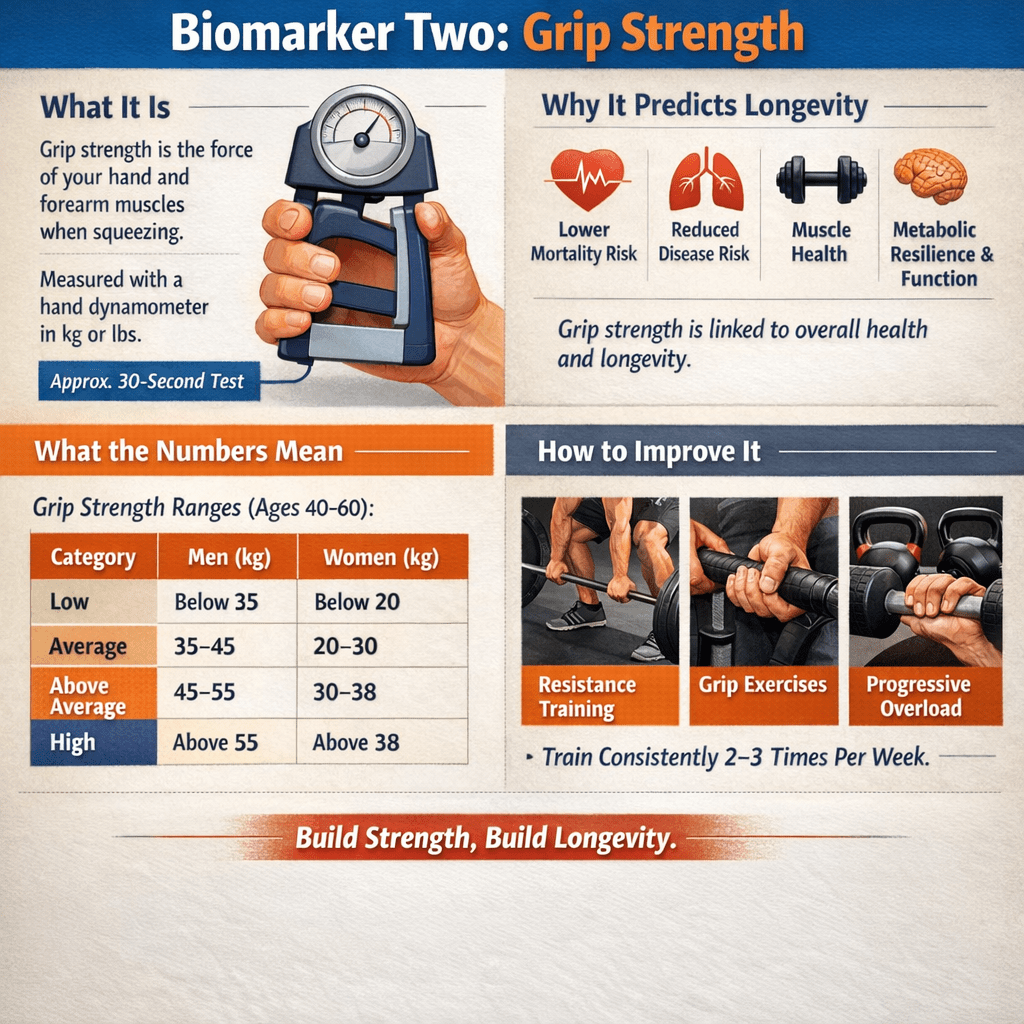
Grip strength is the maximum force your hand and forearm muscles can generate when squeezing. It is typically measured with a hand dynamometer in kilograms or pounds of force and takes approximately 30 seconds to test.
Of all the biomarkers on this list, grip strength is the most underestimated and the most surprising to people encountering this research for the first time.
Why It Predicts Longevity
Grip strength is not just a measure of hand strength. It is a proxy for total body muscle mass, neuromuscular integrity, and systemic physiological reserve.
The research is extensive and consistent. A major meta-analysis published in the British Medical Journal, drawing on data from over 2 million participants across 42 studies, found that low grip strength was associated with significantly higher risk of all-cause mortality, cardiovascular disease, respiratory disease, and cancer mortality.
A study published in The Lancet followed nearly 140,000 adults across 17 countries and found that grip strength was a stronger predictor of cardiovascular mortality than systolic blood pressure, which has been the standard cardiovascular risk marker for decades.
Why does hand strength predict heart disease and cancer mortality? Because grip strength reflects the overall integrity of your musculoskeletal system. Muscle mass is metabolically active tissue. It regulates glucose metabolism, insulin sensitivity, and inflammatory signaling. The more muscle you maintain, the more metabolically resilient you are. And metabolic resilience is one of the central mechanisms underlying longevity.
Grip strength also predicts functional independence in older age with remarkable precision. The ability to open jars, carry groceries, lift yourself from a chair, and recover from a stumble before it becomes a fall all depend on the same neuromuscular foundation that grip strength measures.
Falls are one of the leading causes of death and disability in adults over 65. Grip strength, measured decades earlier, predicts fall risk with significant accuracy.
What the Numbers Mean
Reference ranges vary by age and sex. As a general guide for adults aged 40 to 60:
| Category | Men (kg) | Women (kg) |
|---|---|---|
| Low | Below 35 | Below 20 |
| Average | 35–45 | 20–30 |
| Above Average | 45–55 | 30–38 |
| High | Above 55 | Above 38 |
The trajectory matters as much as the absolute number. Declining grip strength over time is a more sensitive warning signal than a single low reading.
How to Improve It
Grip strength improves as a natural byproduct of consistent resistance training, particularly exercises that involve heavy loads and direct grip demands.
Deadlifts, farmer’s carries, pull-ups, barbell rows, and kettlebell swings all build grip strength while simultaneously developing the broader musculoskeletal foundation that grip strength reflects.
Direct grip training, using thick-handled implements, grip trainers, or simply holding heavy loads for time, accelerates the development beyond what compound lifting alone produces.
The most important principle is progressive overload: consistently increasing the demand on your musculoskeletal system over time. This is what prevents the age-related decline in muscle mass known as sarcopenia, which is the physiological mechanism underlying grip strength’s predictive power for mortality.
Aim for at least two to three sessions of resistance training per week with progressive loading. This alone, maintained consistently over decades, is one of the highest-return longevity investments available.
Biomarker Three: Heart Rate Variability (HRV)
What It Is
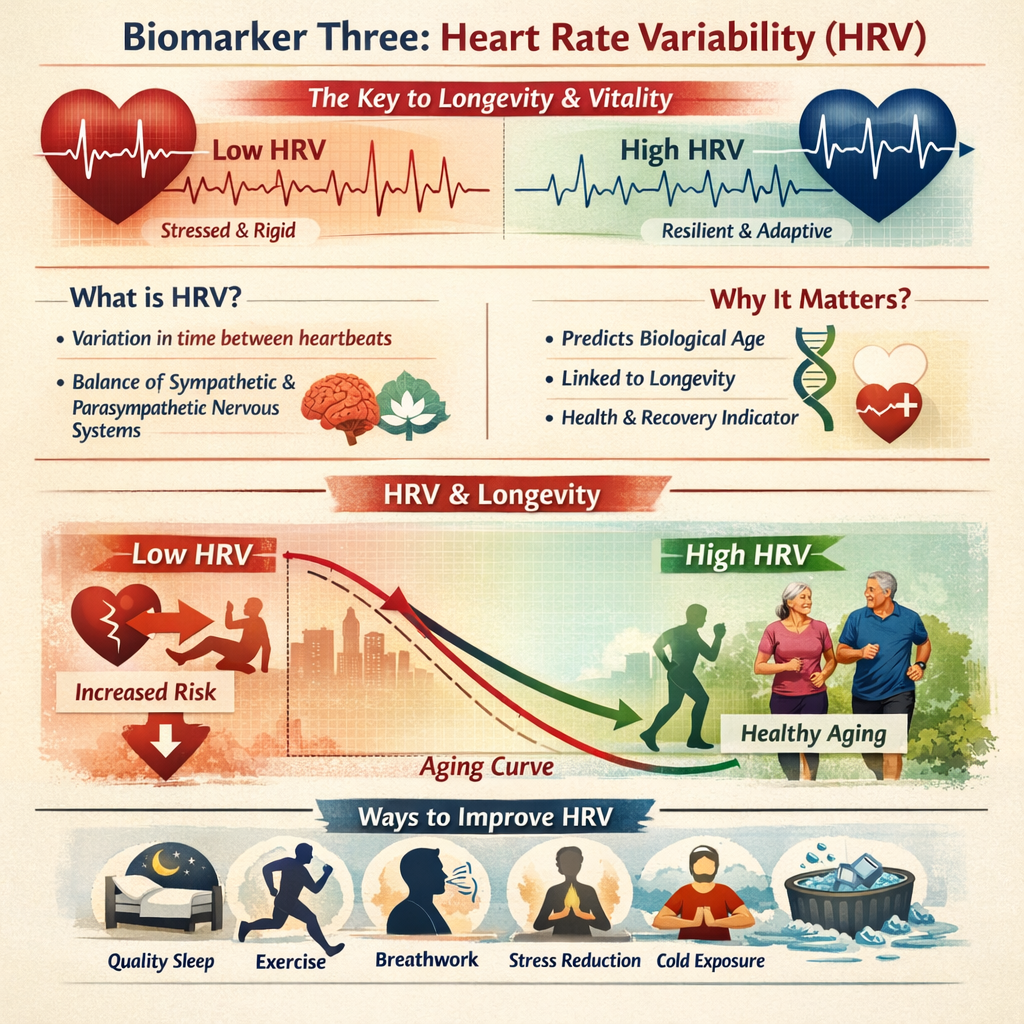
Heart rate variability is the variation in time intervals between consecutive heartbeats. Despite what the name suggests, a higher HRV is associated with better health. A heart that beats with robotic regularity, the same interval between every beat, is actually a sign of a less adaptable, less resilient cardiovascular system.
HRV reflects the balance between your sympathetic nervous system (the fight-or-flight system) and your parasympathetic nervous system (the rest-and-recover system). Higher HRV indicates that your autonomic nervous system is flexible, responsive, and well-regulated. Lower HRV indicates chronic stress, poor recovery, or underlying pathology.
Why It Predicts Longevity
HRV has emerged as one of the most sensitive and comprehensive biomarkers in longevity research precisely because it measures nervous system function rather than a single organ or system.
The autonomic nervous system regulates heart rate, blood pressure, digestion, immune function, hormonal balance, and the stress response. HRV gives you a real-time window into the health of this entire regulatory system.
Research published in the European Heart Journal found that low HRV was associated with significantly increased risk of cardiovascular mortality, independent of traditional risk factors including cholesterol, blood pressure, and body weight.
Longitudinal studies have found that HRV declines with age at a predictable rate, but that the rate of decline varies enormously between individuals based on lifestyle factors. People who exercise consistently, sleep well, manage stress effectively, and maintain social connection show significantly slower HRV decline than sedentary, sleep-deprived, chronically stressed counterparts of the same chronological age.
This is the profound insight embedded in HRV as a longevity biomarker: it measures biological age, not chronological age. A 55-year-old with high HRV may have the autonomic nervous system profile of a 40-year-old. A 40-year-old with chronically low HRV may have the profile of a 60-year-old.
HRV is also acutely sensitive to lifestyle inputs, making it an exceptionally useful feedback tool for optimizing daily behavior. A night of poor sleep, an evening of excess alcohol, a period of high psychological stress, an overreaching training week: all of these show up clearly in HRV data within 24 to 48 hours.
This makes HRV not just a longevity predictor but a daily dashboard for how well your current lifestyle is serving your long-term health.
What the Numbers Mean
HRV is measured in milliseconds (ms) and varies significantly between individuals based on age, fitness, genetics, and measurement method. Unlike VO2 max and grip strength, absolute HRV numbers are less meaningful than your personal baseline trend.
General reference points for resting HRV measured in the morning:
| Age Group | Low HRV | Average HRV | High HRV |
|---|---|---|---|
| 20s–30s | Below 40ms | 40–70ms | Above 70ms |
| 40s–50s | Below 30ms | 30–55ms | Above 55ms |
| 60s+ | Below 20ms | 20–40ms | Above 40ms |
The most useful HRV practice is tracking your own baseline over weeks and months and noticing what lifestyle factors consistently raise or lower it.
How to Improve It
HRV responds to a surprisingly diverse set of lifestyle inputs, which makes it one of the most actionable biomarkers to improve.
Sleep quality is the single most powerful lever. HRV is predominantly recovered during deep sleep. Protecting sleep duration and quality, consistent sleep timing, cool dark room, minimal alcohol, and limited blue light exposure in the evening, produces some of the fastest HRV improvements of any intervention.
Zone 2 cardio training consistently raises baseline HRV over weeks to months by strengthening parasympathetic tone and cardiac vagal activity. This is one of the reasons Zone 2 training appears in virtually every longevity protocol.
Breathing practices have direct, measurable effects on HRV. Slow diaphragmatic breathing at approximately 5 to 6 breaths per minute (known as resonance frequency breathing) produces significant acute HRV increases and cumulative improvements with regular practice.
Stress management matters enormously. Chronic psychological stress is one of the strongest suppressors of HRV. Any practice that reduces allostatic load, whether meditation, time in nature, reduced news consumption, or deliberate recovery time, tends to support HRV improvement.
Cold exposure, consistent with your existing content on cold showers and recovery, has demonstrated acute HRV-boosting effects through its activation of the vagus nerve and parasympathetic system.
The Biomarker Triangle
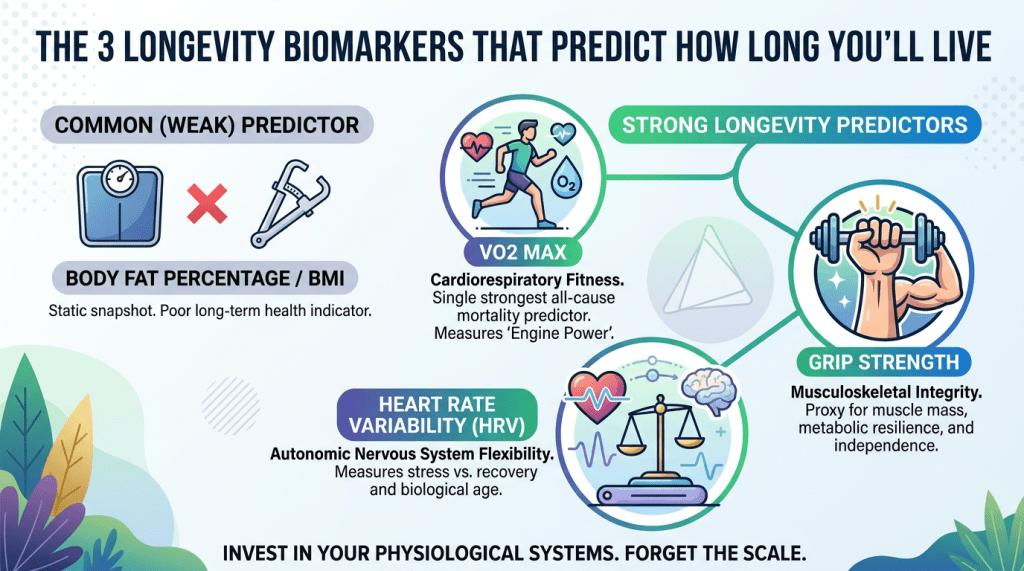
These three biomarkers are not independent. They form a triangle of reinforcing physiological systems.
VO2 max reflects the strength and efficiency of your cardiovascular and metabolic engine. Grip strength reflects the integrity of your musculoskeletal system and metabolic reserve. HRV reflects the health and adaptability of your autonomic nervous system, which regulates both of the others.
Improve one, and the others tend to follow. Train your cardiovascular system through Zone 2 cardio and your HRV rises. Build your musculoskeletal base through resistance training and your metabolic resilience improves, which benefits both cardiovascular function and nervous system regulation. Optimize your recovery through sleep and stress management and your HRV rises, your training quality improves, and your VO2 max and strength gains accelerate.
This is the compounding effect of targeting the right biomarkers. Unlike body fat, which is a single-system metric with limited systemic leverage, these three biomarkers are deeply interconnected levers. Improving them simultaneously produces health gains that are greater than the sum of their parts.
How to Start Measuring
You don’t need a laboratory or an expensive clinical assessment to begin tracking these biomarkers.
VO2 max can be estimated using consumer wearables like Garmin, Apple Watch, or Polar devices with reasonable accuracy. For a more precise measurement, a VO2 max test at a sports performance lab or university exercise science department is widely available and typically costs between $100 and $200.
Grip strength can be measured with a hand dynamometer, available for $20 to $40 online. Test both hands, average three attempts per hand, and track the number monthly.
HRV is measurable with most modern fitness wearables. Whoop, Garmin, Oura Ring, and Apple Watch all provide HRV tracking. For the most accurate readings, measure first thing in the morning before getting out of bed, at the same time each day, using the same device and method consistently.
The goal is not perfection on day one. The goal is establishing a baseline and tracking the trend over months and years. A rising trend across all three biomarkers is one of the clearest signals available that your lifestyle is working in service of your long-term health.
The Longevity Investment Thesis
Here is the framing that ties everything together for the FIRE-minded reader.
You already understand compound interest. You know that small, consistent investments made early produce disproportionate returns over decades. You know that the most important financial decisions are not the dramatic ones but the boring, consistent ones maintained over time.
Longevity works the same way.
Every Zone 2 session is a deposit into your VO2 max account. Every resistance training session is a deposit into your musculoskeletal reserve. Every night of quality sleep, every breathing practice, every stress management habit is a deposit into your autonomic resilience.
These deposits compound. The person who trains consistently through their 30s and 40s arrives at 60 with a physiological age a decade younger than their chronological age. They have more energy, more capability, more independence, and statistically more years of healthy life ahead of them.
Body fat is what you look like. These three biomarkers are what you’re capable of. And in the long game of a well-lived life, capability compounds in ways that appearance never will.
Track the right numbers. Train the right systems. And watch your healthspan extend in ways that no scale will ever show you.
The best time to start improving these biomarkers was ten years ago. The second best time is today. Pick one, measure it, and begin.
Related Reading
If this post resonated, these related posts will deepen your thinking:
- VO2 Max and Longevity: How to Improve It Without Burnout
- Why Grip Strength Predicts Longevity (And How to Improve It)
- Heart Rate Variability: What HRV Says About Stress & Recovery
- Metabolic Flexibility: What It Is, Why It Matters, and How to Improve It
- The Minimum Effective Longevity Habits: What Actually Improves Healthspan
- Zone 2 Cardio Explained: The Boring Workout That Boosts Longevity and Adds Years to Your Life
- Habits That Matter After 40: What Actually Improves Longevity
- Training for Longevity: How to Exercise for Long-Term Health, Not Just Looks


Leave a comment