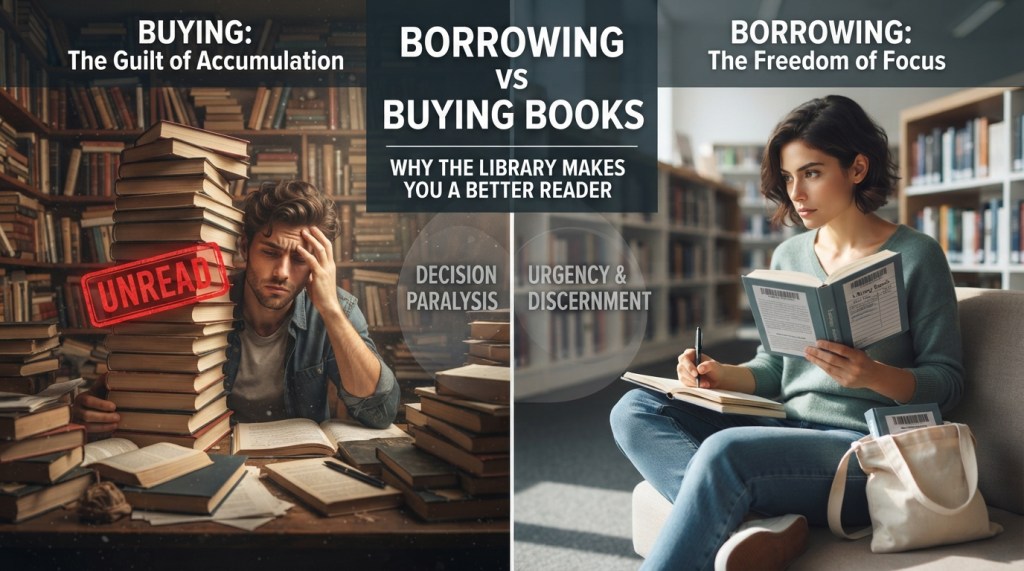
There’s a particular kind of guilt that only readers know.
It lives on your bookshelf. It stares at you from the stack on your nightstand. It follows you every time you walk past the spare room where the overflow books have migrated.
It’s the guilt of unread books. The ones you bought with great intentions, shelved with optimism, and haven’t touched since.
Meanwhile, your local library — free, quiet, endlessly stocked — sits largely ignored.
Here’s the counterintuitive truth that experienced readers eventually discover: borrowing books instead of buying them doesn’t just save money. It makes you a sharper reader, a more decisive thinker, and a more intentional learner.
This blog is about why that is — and how to use the library as a serious tool for intellectual growth.
The Book Buying Illusion
There’s a psychological phenomenon called the Diderot Effect — named after the French philosopher Denis Diderot, who wrote an essay about how receiving a beautiful scarlet dressing gown led him to replace everything in his study to match it. One purchase spiraled into many.
Book buying works similarly, but in reverse.
Each book you buy feels like an investment in your future self. The person who will read about behavioral economics, ancient philosophy, nutrition science, and the history of cartography — all in the same month. You’re not buying a book. You’re buying an identity. The identity of someone who reads widely, thinks deeply, and has excellent taste.
The problem is that identity purchase and actual reading are two completely different activities.
Research in consumer behavior has found that people consistently overestimate how much they’ll use, watch, read, or engage with things they purchase. The act of buying creates a feeling of completion — a sense that the goal has been partially achieved — which paradoxically reduces the motivation to actually follow through.
In reading, this is called “completionist purchasing”. You buy the book. Your brain registers a small reward. The urgency to read it dissolves.
This is why so many ambitious readers have shelves full of books they’ve never opened.
Borrowing breaks this pattern entirely.
The Deadline Effect: Why Constraints Make You Read More
When you borrow a book from the library, something changes immediately.
You have a return date.
That deadline — typically two to three weeks — does something that no amount of personal motivation can reliably replicate: it creates genuine urgency.
Not manufactured urgency. Not a self-imposed promise. A real, external constraint with a real consequence (late fees, or the guilt of keeping a book someone else is waiting for).
Deadlines are one of the most well-researched productivity tools in behavioral psychology. Parkinson’s Law states that work expands to fill the time available for its completion. Applied to reading: if you have unlimited time to read a book, you will take unlimited time.
Give yourself three weeks, and suddenly the book moves to the top of your stack. You read on your lunch break. You read before bed. You carry it in your bag.
The library doesn’t just lend you a book. It lends you the motivation to read it.
This is one of the most underappreciated benefits of library borrowing — not just for casual readers, but for serious ones. The constraint of a return date is a forcing function that purchased books simply cannot replicate.
How Borrowing Improves Decision Making
Here’s the connection that most people miss — and the real reason this strategy improves your thinking over time.
When you buy books, the barrier to acquisition is low. A good review, a recommendation from a podcast, an interesting cover — any of these can trigger a purchase. You accumulate books faster than you can read them, which creates a reading pile that grows beyond your ability to engage with it meaningfully.
The result is decision paralysis. Too many options. Too many directions. No clear priority. You stand in front of your bookshelf for five minutes trying to decide what to read next and end up scrolling your phone instead.
When you borrow books, you introduce a natural filter.
To borrow a book from the library, you have to:
- Decide you actually want to read it — not just own it
- Check availability — sometimes it’s not immediately available, which gives you time to reconsider
- Go and get it — a small but real friction that separates genuine interest from impulse
- Commit to reading it within the loan period — or accept that you’re wasting your time
This process is a decision-making workout. You practice discernment. You develop the habit of asking: Do I actually want to read this, or do I just like the idea of having read it?
That question — practiced repeatedly over hundreds of borrowing decisions — sharpens your judgment in ways that extend far beyond books.
The library doesn’t just help you read better. It trains you to choose better.
The Ownership Paradox: Why Owning Books Can Work Against You
There’s a romantic notion in reading culture that book ownership is sacred. That writing in the margins, dog-earing pages, and displaying your collection is part of the reading life.
And there’s truth in that — for certain books.
But ownership also creates a subtle psychological burden that most readers never examine.
When you own a book, you feel obligated to finish it. Even when it’s not serving you. Even when you’ve extracted the main insight by chapter four and the remaining chapters are repetition. Even when it’s simply not the right book for where you are right now.
This obligation — the sunk cost of having paid for something — keeps you reading books you should have put down, at the expense of books that would have genuinely changed your thinking.
Borrowed books don’t carry this burden.
If a borrowed book isn’t working for you, you return it. No guilt. No lost investment. No shelf presence reminding you of your failure to finish. You simply return it and move on.
This is what experienced readers call “reading without obligation” — the freedom to engage with a book on its own merits, to take what’s valuable and leave the rest, without the psychological weight of ownership distorting your judgment.
The paradox is real: owning fewer books, and borrowing more, often results in reading more deeply and retaining more meaningfully.
The Curation Advantage: Why Library Collections Are Underrated
Here’s something that Amazon’s recommendation algorithm will never tell you:
The books that have been in your local library for twenty years — the ones with cracked spines and faded covers — are almost certainly better than the bestseller your social media feed is promoting this week.
This connects directly to what Nassim Taleb calls the Lindy Effect: the longer a book has been in circulation, the longer it’s likely to remain relevant. A book that has been continuously borrowed, read, and returned for three decades has proven its value across thousands of readers and multiple cultural moments.
A new release hasn’t proven anything yet.
Library collections, particularly in well-established branches, are curated by this principle without even trying. The books that didn’t deliver value stopped being borrowed and were quietly removed. The ones that remained are the ones that kept finding readers.
When you browse a library rather than a bookstore, you’re navigating a collection that has been filtered by decades of genuine reader engagement — not by marketing budgets, publisher advances, or influencer promotions.
That’s a remarkably powerful curation mechanism that most readers completely overlook.
What Borrowing Does to Your Reading Identity
There’s a deeper shift that happens when you make the library your primary reading source.
You stop reading to own. You start reading to learn.
These sound similar. They’re not.
Reading to own is about acquisition — adding to your collection, completing your library, building the identity of someone who has read widely. It’s externally oriented. It’s about the shelf, the display, the signal.
Reading to learn is about transformation — changing how you think, what you understand, how you see the world. It’s internally oriented. It’s about what happens in your mind, not what appears on your walls.
The library enforces reading to learn by removing the possibility of reading to own. You can’t keep the book. You can only keep what you took from it.
This reorientation — subtle but profound — changes how you read. You slow down. You pay more attention. You take notes because the book won’t be there tomorrow to reference. You engage more actively because you know the clock is running.
Borrowed books make you a more present, more attentive, more engaged reader.
The Financial Case (That Isn’t Just About Money)
The obvious argument for library borrowing is financial: books are expensive, libraries are free.
But the financial case goes deeper than the cover price.
Consider what most dedicated readers spend annually on books. Even a modest habit — two or three books per month — adds up to several hundred dollars a year. A serious habit can reach into the thousands.
Now consider the return on that investment.
If you’re buying books faster than you can meaningfully read and absorb them, your effective return per dollar is low. You’re accumulating content, not building knowledge. The marginal value of each additional purchased book decreases as your unread pile grows.
The library inverts this equation.
When every book costs you nothing financially but requires a real commitment of time and attention, you naturally become more selective. You borrow fewer books simultaneously. You read each one more carefully. You extract more value from each reading experience.
This is the compound reading effect: fewer books, read more deeply, retained more thoroughly, applied more consistently — produces dramatically better intellectual returns than more books, skimmed lightly, forgotten quickly, left unfinished on a crowded shelf.
In investing terms: concentration beats diversification when the quality of your selections is high. The library forces you toward that concentration.
How to Use the Library as a Serious Learning Tool
If you’re convinced — or even curious — here’s how to shift your reading practice toward borrowing without losing the depth that serious readers value.
Build a Reading Wishlist First
Before you go to the library, maintain a running list of books you genuinely want to read. Use a notebook, a notes app, or a dedicated reading tracker. When a recommendation comes in — from a podcast, a conversation, an article — add it to the list.
Then, when you visit the library, browse your list rather than the shelves. This prevents impulse borrowing (which has the same problems as impulse buying) and ensures you’re always reading something that aligns with your current learning priorities.
Borrow One Book at a Time (Or Maximum Two)
The temptation when you first embrace library borrowing is to borrow six books at once because they’re free. Resist this.
One or two books at a time creates the same forcing function as a single deadline. You know what you’re reading next. You’re not fragmenting your attention across five half-started books. You finish before you begin something new.
This sounds restrictive. It’s actually liberating.
Use the Hold System Strategically
Most library systems allow you to place holds on books that are currently checked out. Use this deliberately.
When you finish a book and return it, check your holds queue. If your next book isn’t available yet, that gap — the waiting period — becomes a natural reading rest. A moment to reflect on what you just read before diving into the next thing.
Experienced readers know that the space between books is often as valuable as the books themselves. The library’s hold system creates that space automatically.
Allow Yourself to Return Books Unfinished
This is the most important habit shift.
If a borrowed book isn’t working — if it’s not delivering on its premise, if the timing isn’t right, if you’ve extracted what you needed by chapter five — return it.
No guilt. No obligation. No internal negotiation.
This practice builds the reading discernment that separates serious readers from collectors. Not every book deserves to be finished. The ones that do will demand your full attention without you needing to force it.
Keep Your Own Books for Reference and Re-Reading
This is where buying makes absolute sense.
Books you know you’ll return to — reference texts, foundational works in your field, books that genuinely changed how you think — these are worth owning. Annotate them. Dog-ear them. Keep them on your desk.
But the initial reading? The first encounter with a new author, a new subject, a new idea? Borrow it first. If it earns a place on your permanent shelf, buy it after.
This two-stage approach — borrow first, buy only what earns it — is how serious readers build collections that are genuinely meaningful rather than aspirationally decorative.
The Reading Life You Actually Want
Most readers want the same thing: to read more, retain more, and actually apply what they learn.
The irony is that buying more books — the instinctive response to wanting to read more — works against all three goals simultaneously. It creates guilt, dilutes attention, and turns reading into an obligation rather than a practice.
The library offers something different.
It offers books without baggage. Reading without obligation. Learning without accumulation.
It offers the freedom to read exactly what you need, exactly when you need it, with exactly the right amount of urgency to ensure you actually do it.
The library isn’t a compromise for people who can’t afford books.
It’s a system for people who take reading seriously enough to do it well.
Related Reading
If this resonated, you might enjoy these:
- Reading Debt: How to Stop Feeling Guilty About Your Unread Books and Overwhelmed TBR Pile
- Why Old Books are Better Than Bestsellers: The Lindy Effect
- How to Learn More From Books: Why Owning Fewer Books Can Make You Smarter
- How to Build a Consistent Reading Habit That Lasts for Personal Growth
- Why Book Summaries Fail: The Truth About Reading Retention
- How to Read for Retention: Why Reading Too Fast is a Mistake
- The Reading Flywheel: How to Remember, Apply, and Learn More From Books
- Cognitive Nutrition: Why Information Quality Matters More Than Quantity


Leave a comment