There’s an exercise that builds grip strength, improves posture, trains your core, develops cardiovascular fitness, and translates directly into real-world physical capability.
It requires no machines. No cables. No complex programming.
You pick something heavy up. You walk with it. You put it down.
That’s it.
The farmer’s carry — and loaded carries in general — might be the most underrated exercise in modern fitness. While gym culture obsesses over isolation machines, optimized split routines, and mirror muscles, the farmer’s carry quietly does more for your functional health, longevity, and real-world strength than almost anything else you could add to your training.
This blog is about why that is — and how to use it.
What Is a Loaded Carry?
A loaded carry is exactly what it sounds like: you pick up a weight and carry it for distance or time.
The farmer’s carry is the most common variation — you hold a heavy weight in each hand (dumbbells, kettlebells, or trap bar) and walk. But the loaded carry family is broader than most people realize:
- Farmer’s Carry — weight in both hands, arms at sides
- Suitcase Carry — weight in one hand only, challenges lateral stability
- Rack Carry — weight held at shoulder height (kettlebell rack position)
- Overhead Carry — weight pressed overhead, demands shoulder stability
- Zercher Carry — weight held in the crook of the elbows
- Sandbag Carry — awkward, unstable load that mimics real-world objects
- Yoke Carry — a bar across the shoulders carrying heavy loads (strongman territory)
Each variation trains slightly different qualities. But they all share a common thread: they force your entire body to work together to move a heavy load through space.
That’s the key insight. And it’s what makes loaded carries so uniquely valuable.
Why Modern Training Has Forgotten How to Carry
Walk into most commercial gyms and you’ll see a predictable landscape.
Chest press. Lat pulldown. Leg press. Cable curl. Tricep pushdown. Repeat.
These exercises have their place. But they share a fundamental limitation: they train your body in isolation, while you’re seated or supported, in a fixed plane of motion, with the weight guided by a machine.
Real life doesn’t work like that.
Real life asks you to carry groceries from the car in one trip (because you refuse to make two). To move furniture. To lift a child. To carry a backpack across a city for six hours. To haul luggage up three flights of stairs in a European apartment with no elevator.
Real life is a loaded carry.
And most modern training programs — with their machine-based isolation and bilateral symmetry — leave you completely unprepared for it.
The farmer’s carry bridges that gap. It trains the specific combination of grip, core stability, posture, and locomotive strength that real life actually demands.
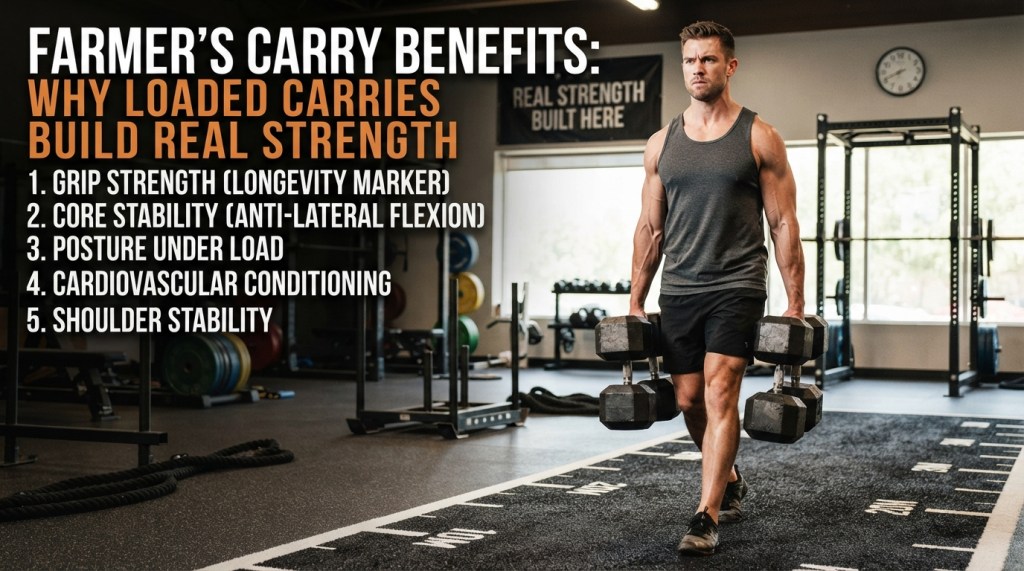
The Farmer’s Carry Benefits: What’s Actually Happening
When you pick up a heavy weight in each hand and walk with it, here’s what your body is doing simultaneously:
1. Grip Strength (Your Longevity Biomarker)
Your hands are working constantly to hold the weight. Every step, every micro-adjustment, your grip is being trained.
This matters more than most people realize.
Grip strength is one of the most reliable predictors of long-term health and longevity. Research published in The Lancet followed over 140,000 adults across 17 countries and found that grip strength was a stronger predictor of cardiovascular mortality than systolic blood pressure. Other studies have linked grip strength to cognitive function, bone density, and all-cause mortality.
When you train the farmer’s carry consistently, you’re not just building a stronger handshake. You’re building one of the most well-researched markers of long-term health.
2. Core Stability (The Kind That Actually Works)
Every fitness marketing campaign promises “core training.” Most of it delivers crunches and planks.
The farmer’s carry delivers something more sophisticated: anti-lateral flexion core stability.
When you hold a heavy weight in one hand (suitcase carry) or two hands (farmer’s carry), your core must resist the pull of gravity trying to bend you sideways. Your obliques, quadratus lumborum, and deep spinal stabilizers fire continuously to keep you upright and moving in a straight line.
This is functional core training. Your core wasn’t designed to crunch. It was designed to resist forces that try to destabilize your spine. The farmer’s carry trains exactly that.
The result? A core that works in real life — not just one that looks good in photos.
3. Posture Under Load
Most postural problems come from weakness, not just habit. People don’t slouch only because they sit too long. They slouch because their postural muscles aren’t strong enough to maintain alignment when fatigued or under load.
The farmer’s carry is a posture training tool disguised as a strength exercise.
To carry heavy weight without collapsing forward, your upper back must stay braced. Your shoulders must be pulled back and down. Your neck must stay neutral. Your chest must stay open.
Walk with heavy dumbbells for 40 meters while maintaining perfect posture — and you’ll feel muscles in your upper back and between your shoulder blades that a year of sitting-based “posture exercises” never touched.
Do this consistently and you don’t just have better posture in the gym. You have better posture everywhere.
4. Cardiovascular Conditioning
Don’t be fooled by the simplicity of walking.
Load up a farmer’s carry at a challenging weight and walk 50 meters without stopping. Your heart rate will be elevated. Your breathing will be labored. Your entire body will be working.
Loaded carries create a unique metabolic demand — they combine the strength requirements of heavy lifting with the cardiovascular demands of sustained effort. This makes them an extremely efficient conditioning tool, particularly for people who find traditional cardio monotonous or who want to combine strength and conditioning work without doubling their training time.
For FIRE (Financial Independence, Retire Early)-minded people and busy professionals who optimize everything: the farmer’s carry gives you strength training and cardiovascular conditioning in a single movement. That’s exceptional return on time invested.
5. Shoulder Stability and Health
The shoulder is the most mobile joint in your body — which also makes it the most vulnerable. Shoulder injuries are among the most common training complaints, particularly in people who press heavy without adequate stability work.
The farmer’s carry loads the shoulder in a hanging position, which trains the rotator cuff, lower trapezius, and serratus anterior to stabilize the joint under load. This is exactly the kind of work that protects shoulders over the long term.
For older athletes especially — and for anyone doing significant overhead pressing — loaded carries are essential shoulder prehabilitation work.
6. Single-Leg Stability and Gait
Walking is a single-leg sport. Every step requires one leg to stabilize your entire body weight while the other swings forward.
Add heavy load to that equation and you’ve dramatically increased the stabilization demand on your hips, glutes, and ankles. The farmer’s carry trains the entire lower body’s stabilization system in a way that squats and deadlifts — valuable as they are — simply don’t replicate.
This translates directly to better balance, more stable walking patterns, and reduced injury risk as you age.
7. Mental Toughness and Discomfort Tolerance
This one doesn’t show up on any exercise science paper. But it’s real.
Carrying something heavy — truly heavy — for distance is uncomfortable. Your grip burns. Your traps ache. Your core fatigues. And you keep walking anyway.
That practice of choosing to continue under discomfort, of not putting the weight down before you reach your target, builds something that transfers far beyond the gym. It builds the quiet confidence that comes from knowing you can handle hard things.
This might sound abstract. But ask any serious strength athlete what loaded carries taught them and they’ll tell you: it’s not just physical.
How to Program Loaded Carries
The farmer’s carry is versatile enough to fit into almost any training program. Here’s how to use it effectively:
If You’re a Beginner
Start with light dumbbells and focus entirely on posture and breathing.
- Weight: Start at 30–40% of your bodyweight total (split between both hands)
- Distance: 20–30 meters per set
- Sets: 3–4 sets
- Rest: 60–90 seconds between sets
- Frequency: 2x per week
Walk tall. Shoulders back. Eyes forward. Breathe steadily. Put the weight down before your form breaks.
If You’re Intermediate
Increase weight progressively and introduce variations.
- Weight: 50–75% of bodyweight total
- Distance: 30–50 meters per set
- Variations: Alternate farmer’s carry with suitcase carry to address asymmetries
- Sets: 4–5 sets
- Frequency: 2–3x per week
At this level, you can also use carries as a conditioning finisher at the end of your strength session. 3–4 heavy sets of farmer’s carry after your main lifts will elevate your heart rate and leave you with a conditioning effect that rivals cardio.
If You’re Advanced
Use carries to address specific weaknesses and build serious work capacity.
- Weight: 75–100%+ of bodyweight total
- Variations: Overhead carry, rack carry, mixed carries (different implements in each hand)
- Structure: Carry complexes — for example, 20m farmer’s carry + 20m rack carry + 20m overhead carry as one set
- Frequency: 2–3x per week, incorporated into conditioning blocks
At advanced levels, carries can also be used for loaded aerobic work — moderate weight carried for longer distances (100–200m+) to develop cardiovascular base while maintaining strength.
Where to Add Carries in Your Training Week
The farmer’s carry is flexible. Here are the most effective placement options:
| Position in Session | Effect |
|---|---|
| After main strength work | Conditioning finisher, grip work |
| Before main lifts (light) | Activation, posture priming |
| As standalone conditioning | Metabolic, aerobic capacity |
| On rest days (light weight) | Active recovery, movement quality |
The most common and effective approach is after your main strength work — 3–5 heavy sets of farmer’s carry as a finisher. This takes 8–12 minutes and adds significant training value without significantly extending your session.
Common Mistakes to Avoid
Mistake 1: Going Too Light
The farmer’s carry only works when the weight is genuinely challenging. If you can carry it for 200 meters without your grip or posture being tested, it’s too light. This isn’t a stroll. It’s a loaded effort.
Mistake 2: Shrugging the Shoulders
A common compensation pattern — people shrug their shoulders toward their ears when the weight gets heavy. This loads the upper traps excessively and takes the lower trapezius and rotator cuff out of the equation. Keep shoulders packed down and back throughout.
Mistake 3: Leaning to One Side
Especially with the suitcase carry (single arm), people lean away from the weight. The whole point is to resist that lean. Stay vertical. Your obliques should be working hard to keep you upright.
Mistake 4: Looking Down
Keep your eyes forward and chin neutral. Looking at the ground compromises your cervical spine and your posture. Pick a point ahead and walk toward it.
Mistake 5: Putting the Weight Down Too Early
Set a distance target before you start. Walk to it before you put the weight down. The adaptation comes from sustained effort — not from stopping the moment it gets uncomfortable.
The Bigger Picture: Why Loaded Carries Are a Longevity Practice
Everything that makes the farmer’s carry valuable in the gym makes it valuable for the rest of your life.
Grip strength declines with age — loaded carries slow that decline. Postural integrity deteriorates with decades of desk work — loaded carries build the muscular foundation to resist it. Balance and single-leg stability decrease after 40 — loaded carries train exactly those systems.
And perhaps most importantly: the farmer’s carry keeps you capable. It keeps you strong enough to lift heavy things, carry awkward loads, move through the world with physical confidence.
That capability — the ability to use your body effectively in real life — is what the fitness industry calls “functional strength.” But it’s really just the physical prerequisite for an independent, active life as you age.
The farmer’s carry isn’t a trendy exercise. It’s not a fitness hack. It’s one of the oldest and most fundamental human movement patterns — picking something up and moving it from one place to another.
It’s what humans have always done.
The gym just gave it a name.
Start Simple. Start Today.
If you take nothing else from this blog, take this:
Pick up something heavy. Walk with it. Put it down. Repeat.
You don’t need a program. You don’t need a gym. You don’t need a coach watching your form on day one. Grab two dumbbells, two kettlebells, or two heavy bags of groceries. Walk to the end of your street and back.
That’s your first farmer’s carry.
Build from there. Add weight when it gets easy. Increase distance gradually. Introduce variations when you’re ready.
In six months, you’ll have a grip like a vice, a core that works under load, posture you didn’t have to think about, and a body that moves through the world with quiet, real-world strength.
Not mirror strength. Not machine strength.
Real strength. The kind that actually matters.
Related Reading
If this resonated, you might enjoy these:
- Why Grip Strength Predicts Longevity (And How to Improve It)
- Strength Training for Longevity: The Muscle Retirement Plan
- Training for Longevity: How to Exercise for Long-Term Health, Not Just Looks
- How to Fix Bad Posture: A 10-Minute Self-Assessment
- Daily Mobility for Joint Health: Small Movements That Pay Off for Decades
- How to Train After 30: A Complete Guide to Strength, Mobility, and Longevity
- The Hidden Injuries of Sitting All Day (and How to Fix Them Early)
- Why You Need More Rest Days After 40 (Not More Intensity)


Leave a comment