We love to optimize.
If you are reading this, you probably know your VO2 max. You likely track your sleep score every morning, buy expensive NAD+ boosters, and agonize over whether you should be doing Zone 2 cardio for 30 minutes or 45 minutes. We treat our bodies like high-performance engines, tuning them with data, supplements, and structured workout plans.
But in our pursuit of the cutting edge – the red light therapy, the cold plunges, the continuous glucose monitors – we often overlook the boring fundamentals. Specifically, we overlook the biology happening right behind our lips.
There is a debate that has raged in cardiology and dentistry for decades: Does the health of your mouth actually dictate the health of your heart?
For a long time, the answer from traditional medicine was a skeptical “probably not”. Doctors viewed gum disease as a localized infection – a problem for the dentist, not the cardiologist. That view is rapidly collapsing under the weight of new research.
It turns out that flossing might be the highest Return on Investment (ROI) habit in your entire arsenal. It costs pennies per day, takes five minutes, and targets one of the primary drivers of systemic aging: chronic inflammation.
Here is why you need to start viewing your toothbrush and floss not as tools for cleaning, but as tools for longevity.
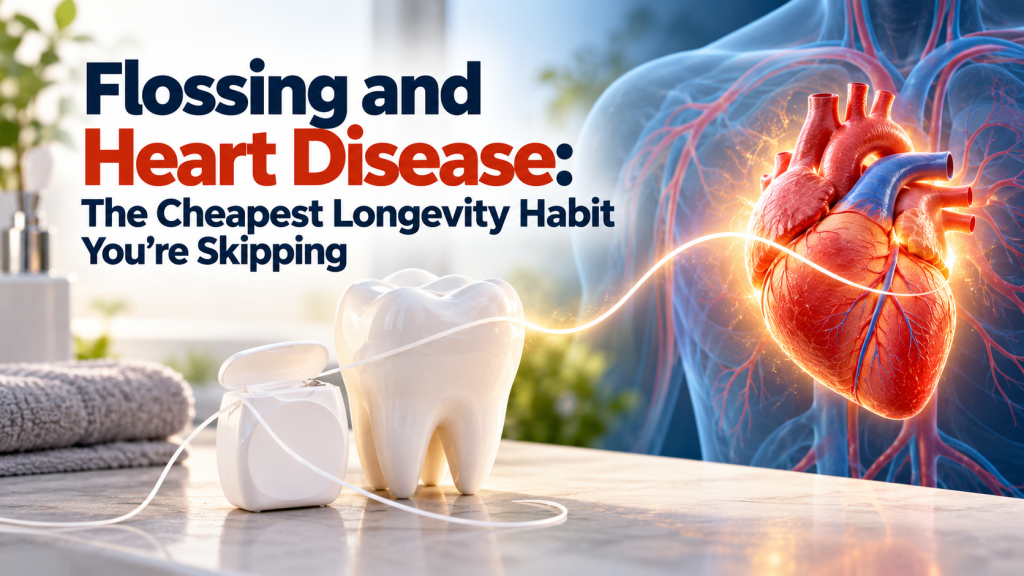
The Oral-Systemic Axis: Your Mouth is not an Island
To understand why flossing matters for your heart, we have to dismantle the idea that your mouth is isolated from the rest of your body.
Your gums are essentially tissue—with a rich blood supply. They are also a border checkpoint. When you eat, bacteria form a biofilm on your teeth called plaque. If you don’t remove this plaque, it hardens into tartar and irritates the gum line. This condition, known as gingivitis, eventually progresses to periodontitis, where the gums pull away from the teeth, creating infected pockets.
Here is where the danger starts. Periodontitis isn’t just a surface-level sore; it’s an active, open wound inside your body.
1. The Fire of Inflammation
When your gums are chronically inflamed, your body is in a state of constant, low-grade warfare. It releases inflammatory markers- specifically C-reactive protein (CRP) and interleukin-6 – to fight the bacterial invasion.
You may know CRP from your annual bloodwork. High CRP is a major predictor of cardiovascular disease. It damages the endothelial lining of your arteries (the delicate inner skin of your blood vessels). When that lining is damaged, cholesterol finds it easier to embed itself there, forming plaques that lead to blockages. Essentially, the inflammation in your mouth is lighting a fire that scorches your arteries.
2. Bacterial Invasion
It sounds like science fiction, but it is a proven medical reality. The bacteria residing in infected gums – most notably Porphyromonas gingivalis – do not stay confined to your mouth. Simple daily actions like chewing, aggressive brushing, or flossing can force these bacteria straight into your bloodstream, causing transient bacteremia. While a healthy immune system quickly clears occasional bacteria, daily gum bleeding acts as a constant gateway, introducing these pathogens into your circulation multiple times a day. Researchers have discovered these exact oral bacteria living inside atherosclerotic plaques in heart arteries, where they actively drive arterial damage and promote clot formation.
The Stakes: More Than Just Bad Breath
Let’s look at the numbers. Ignoring oral hygiene doesn’t just mean dentures later in life; it correlates with some of the biggest killers in the western world:
- Heart Disease: According to the American Heart Association and various global studies, individuals with periodontal disease have a 20% to 40% higher risk of developing heart disease than those with good oral health.
- Stroke: The risk of ischemic stroke increases significantly with tooth loss and gum disease, likely due to the same inflammatory mechanisms that cause clots in the heart.
- Endocarditis: While rarer, this is an infection of the inner lining of the heart chambers and valves. It occurs when bacteria from another part of your body (like your mouth) spread through your bloodstream and attach to damaged areas in the heart.
- Pneumonia: This is especially relevant for travelers or those working in open offices. Inhaling bacteria from infected teeth and gums into your lungs can lead to respiratory infections—a hidden immune system drag you didn’t account for.
The Economic Argument: Why Flossing Beats Most Biohacks
Since I love FIRE (Financial Independence, Retire Early), let’s apply a financial lens to this biological problem.
Cost Analysis of Top Longevity Interventions:
- Red Light Therapy Panel: $300 – $700 upfront + electricity.
- High-Quality Sauna Access/Purchase: $100/month membership or $3,000+ installation.
- NAD+ Precursors (e.g., NMN/NR): $50 – $80 per month.
- Cold Plunge/Ice Bath: High time cost (getting ice) or money ($5,000 tub) + misery tax.
- Daily Flossing: ~$0.05/day (cost of floss) + 4 minutes of time.
Now look at the Inflammation Reduction Potential:
While saunas and light therapy are fantastic for hormesis (good stress), they often require years of consistent use to show statistical changes in all-cause mortality.
Periodontal disease, conversely, is a massive source of chronic bad stress. Removing that source reduces systemic inflammation almost immediately.
If you view your health budget strictly by ROI (Return on Investment), fixing your gum health is an absolute steal. It is the “index fund” of health habits. It isn’t sexy, it won’t give you a dopamine hit like a PR at the gym, but it compounds silently in the background while you sleep.
Why We Resist (and How to Fix It)
So why do only 30% of people floss daily?
It comes down to two things: Lack of Feedback Loops and Friction.
When you skip a day at the gym, you feel weak or sluggish. When you eat junk food, you get a sugar crash or brain fog. When you don’t floss… nothing happens immediately. You wake up the next day fine. The pain of a root canal or the heart issue is decades away. Our brains are wired to discount future rewards/punishments.
Furthermore, string floss is difficult to use. It snaps between fingers, it can’t reach deep pockets, and it requires dexterity early in the morning when our brains are foggy.
To build a system that sticks, you need to remove friction.
The Protocol: A High-Performance Oral System
Don’t rely on motivation. Rely on architecture. Here is how to upgrade your oral care routine from “hygiene” to “longevity optimization”.
1. The Tools (Optimize Hardware)
Throw away the cheap, waxy string floss that shreds. It sucks. No wonder people hate using it.
- The Upgrade: Buy a Water Flosser (like Waterpik or a cordless travel version).
- Why: It uses a pressurized stream of water to blast the biofilm away. Studies suggest water flossing is actually more effective than string floss for reducing bleeding and gingivitis because it reaches deeper below the gum line where bacteria hide.
- Travel Hack: If you are a Digital Nomad, get a cordless, collapsible one. Keep it next to your laptop stand.
2. Timing (Contextual Trigger)
Never leave flossing to willpower (“I’ll do it before bed if I’m not too tired”). You will be too tired.
- The System: Anchor it to an existing habit.
- Option A: Do it in the shower. You’re naked, you’re bored, you have nothing to do with your hands while the conditioner sets. It adds zero extra time to your morning.
- Option B: The “Teeth Nightlight” rule. Floss while listening to the first song of your evening podcast or wind-down routine.
3. Mouth Taping & Nasal Breathing
This is a crossover benefit. If you are sleeping with your mouth open, you are drying out your oral microbiome, creating a breeding ground for anaerobic bacteria that cause gum disease and bad breath.
- Action: Switch to nasal breathing (day and night). This keeps the saliva pH balanced, which is nature’s natural defense against cavity-causing bacteria.
4. Diet: The Sugar/Bacteria Axis
You cannot out-floss a bad diet. The bacteria that cause heart inflammation feed on fermentable carbohydrates.
- Action: If you are snacking constantly (grazing), you are keeping your mouth in a constant acidic state, dissolving enamel and fueling gum inflammation. Stick to Time-Restricted Eating windows. Give your oral immune system a break.
Beyond the Teeth: Nitric Oxide and the Tongue
While we are down here in the oral cavity, let’s discuss one bonus longevity metric: Nitric Oxide (NO).
Your tongue houses bacteria that convert dietary nitrates (from leafy greens and beets) into Nitric Oxide. NO dilates blood vessels, lowers blood pressure, and improves athletic performance.
If you use antiseptic mouthwash (like Listerine), you are nuking this beneficial bacteria along with the bad stuff.
- The Insight: Stop using harsh antiseptic washes unless prescribed. Brush, floss/water pick, and let the good bacteria thrive. Protecting your oral microbiome is as important as protecting your gut biome.
Conclusion
We search for “hacks”. We want the pill, the protocol, the device that extends life by a decade.
But usually, the answer is in the blocking and tackling. The boring stuff.
Flossing – or water flossing – is a direct intervention against systemic inflammation. It protects your vascular system, your cognitive function (via better circulation), and your wallet (via lower dental bills).
It is a tiny hinge that swings a very large door.
Tonight, before you turn off the lights, spend four minutes cleaning the gap. Not for cosmetic reasons. Do it because you are building a body that lasts.
Related Reading
If you enjoyed this deep dive into biological optimization and longevity habits, you’ll find value in these related frameworks from my archives:
- The 3 Longevity Biomarkers That Predict How Long You’ll Live
- Healthspan vs Lifespan: How to Live Better, Not Just Longer
- Minimum Effective Longevity Habits: What Actually Improves Healthspan
- Cold Exposure Benefits: The Science Behind Cold Showers, Recovery, and Longevity
- Heart Rate Variability: What HRV Says About Stress & Recovery
- Zone 2 Cardio Explained: The Boring Workout That Boosts Longevity and Adds Years to Your Life
- Metabolic Flexibility: What It Is, Why It Matters, and How to Improve It
- Biohacking Simplicity: Small Habits, Big Health Gains


Leave a comment