The difference between a transformative solo trip and an exhausting one isn’t luck. It’s how you make decisions before, during, and after.
Solo travel is one of the most clarifying experiences available to a modern person. No committee. No compromise. No consensus required. Every choice — where to eat, how long to stay, when to move — is entirely yours.
That sounds liberating. And it is.
But it also means there’s no buffer. When you make a poor decision alone, you absorb the full consequence. When decision fatigue sets in — and it will — you’re the only one who can course-correct.
Most solo travel advice focuses on logistics: what to pack, where to stay, how to stay safe. That’s useful, but it misses the deeper skill that separates experienced solo travelers from overwhelmed ones.
The skill is decision-making.
This post is a practical framework for thinking clearly, choosing wisely, and designing your solo travel experience so that decisions work for you rather than against you.
Why Decision-Making Is the Core Skill of Solo Travel
When you travel with others, decisions are distributed. Someone else researches restaurants. Another person handles the accommodation. The cognitive load is shared without you even noticing.
Alone, every decision lands on your desk.
Where to stay. How long to stay. Whether to take the night bus or wait for morning. Whether to accept the invitation from the stranger at the hostel bar. Whether the discomfort you’re feeling is growth or a genuine warning signal.
Multiply those micro-decisions across days, weeks, or months, and you’re managing a significant cognitive load — often while sleep-deprived, in a foreign language environment, and without your usual support network.
This is why solo travelers often describe their first extended trip as mentally exhausting in ways they didn’t anticipate. They expected physical tiredness. They didn’t expect decision fatigue.
The solution isn’t fewer decisions. It’s a better system for making them.
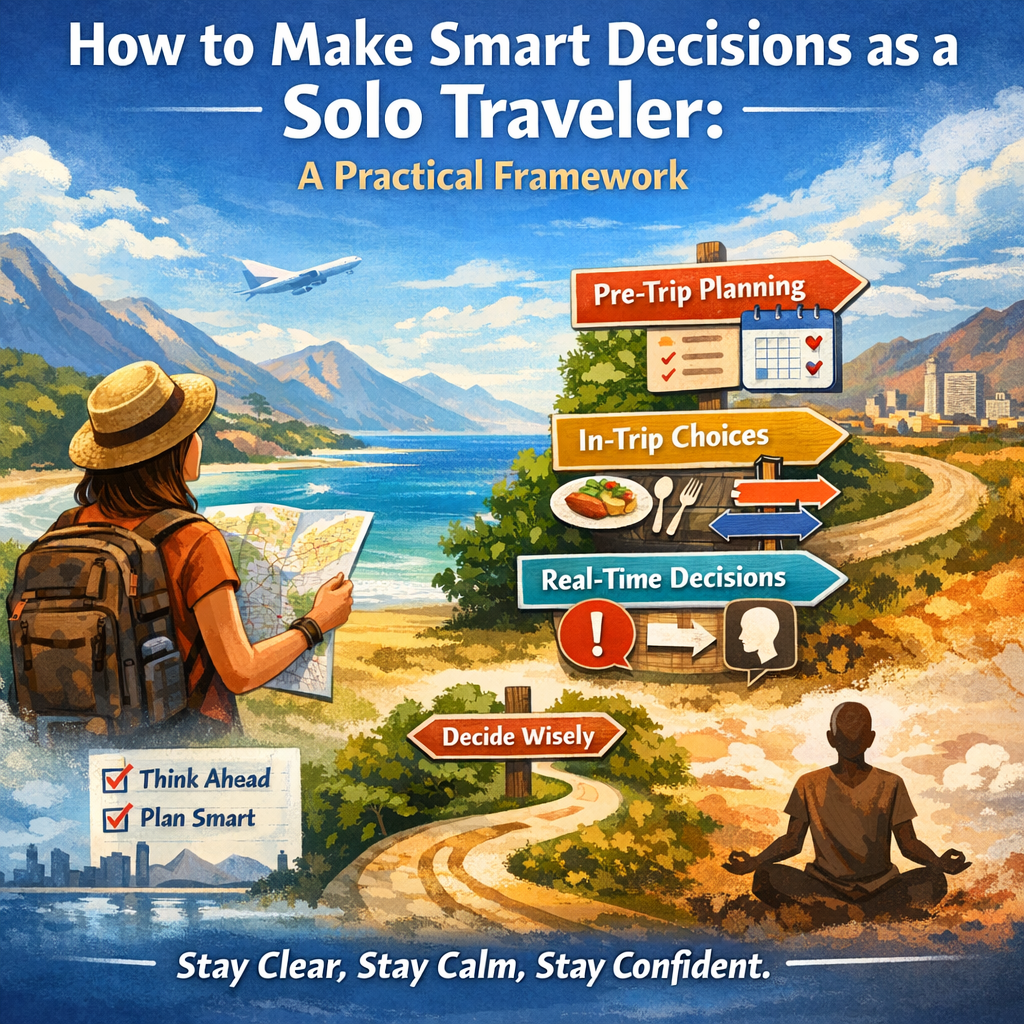
The 3-Layer Decision Framework
Good solo travel decisions operate at three levels. Confusing them is the primary cause of poor choices on the road.
Layer 1: Pre-Trip Architecture Decisions
Layer 2: In-Trip Operational Decisions
Layer 3: Real-Time Instinct Decisions
Each layer requires a different mental tool. Let’s break them down.
Layer 1: Pre-Trip Architecture Decisions
These are the decisions you make before you leave. They set the conditions for every decision that follows.
Most travelers underinvest here. They spend weeks researching destinations and hours comparing flights, but spend almost no time designing the structure of the trip itself.
Architecture decisions include:
- How long will you stay per location? (Slow travel vs. fast travel)
- How much will you pre-book vs. leave open? (Structure vs. optionality)
- What is your energy budget? (High-stimulation vs. restorative)
- What is the trip actually for? (Growth, rest, exploration, skills, creativity)
These aren’t logistical questions. They’re strategic ones. And getting them right simplifies everything downstream.
The Two Constraints Worth Setting
Before you depart, define two hard constraints:
1. Your energy baseline
Are you arriving well-rested or running on fumes? Your decision quality will track your energy almost perfectly. A traveler arriving exhausted from work will make worse decisions in week one than week three. A traveler arriving rested will perform the opposite curve. Know your starting point.
2. Your non-negotiables
Identify two or three things that genuinely protect your wellbeing: sleep schedule, a daily movement practice, a quiet morning hour. These are not luxuries. They are the operating conditions that keep your decision-making sharp. Protect them even when the social pull of travel pushes against them.
Pre-trip architecture decisions are the ones most worth spending time on. Every hour invested here saves multiple hours of confusion on the road.
Layer 2: In-Trip Operational Decisions
These are the recurring decisions that run in the background throughout your trip: where to eat, what to do tomorrow, whether to extend your stay, how to spend a free afternoon.
They seem small. But they compound.
The traveler who handles operational decisions efficiently has more energy for genuine exploration. The traveler who re-litigates every meal, every activity, and every small choice arrives at 4pm mentally depleted and wonders why they’re not enjoying themselves.
The Pre-Decision Rule
The most effective technique for operational decisions is to make them before you need them.
Decide what you’re doing tomorrow at the end of today — not when you wake up and have no plan. Identify two or three restaurant options before you’re hungry — not when you’re starving and overwhelmed by Google Maps.
This is called decision staging, and it dramatically reduces cognitive load.
When you’re calm, well-fed, and rested, you make much better decisions than when you’re tired, hungry, or overstimulated. Pre-staging lets you apply your best mental state to decisions that will affect you during your worst.
The Two-Option Rule
When you’re on the road and need to choose, limit yourself to two options. Not five. Not the entire menu of possibilities.
Identify the top two choices, compare them on one or two dimensions, and commit. The difference between a good choice and a great choice is usually marginal. The cost of over-deliberating is real.
This applies to: restaurants, day trip destinations, accommodation upgrades, route changes, and social invitations.
Pick two. Choose one. Move forward.
When to Break from the Plan
One of the hardest operational decisions in solo travel is knowing when to deviate from your itinerary. You planned four nights somewhere, but by day two you’re restless. Or you planned to leave, but something unexpected is holding your attention.
A useful rule: stay if you’re curious, leave if you’re avoidant.
Extending a stay because you’ve found a rhythm, a community, or a thread worth following — that’s good judgment. Staying because you’re anxious about the next place, haven’t done laundry, or are avoiding a decision — that’s avoidance wearing the mask of flexibility.
The distinction usually becomes clear if you sit quietly with the question for five minutes without your phone.
Layer 3: Real-Time Instinct Decisions
These are the decisions that arrive without warning and require an immediate response.
The unexpected invitation. The situation that feels slightly off. The spontaneous opportunity that wasn’t in any plan. The moment where something in your gut sends a signal before your rational mind has processed the data.
These decisions are where most solo travel advice focuses (safety, instincts, trust your gut) — but without the context of layers one and two, instinct guidance is almost useless. Your gut is only reliable when the rest of your system is functioning well.
Fatigue, hunger, social isolation, and overstimulation all degrade instinct quality. A tired, lonely solo traveler will make systematically different real-time decisions than a rested, socially grounded one — and not better ones.
This is why layers one and two matter so much. They create the conditions under which your instincts can actually be trusted.
The Pause Protocol
For any real-time decision that involves mild risk or significant consequence, apply a simple pause:
Stop. Breathe. Ask: “What would the rested version of me decide?”
That question cuts through decision fatigue, social pressure, and momentary discomfort remarkably effectively. It gives you a reference point — your best self, with access to all your values — rather than your current compromised state.
For safety-specific decisions, the answer is almost always clearer than it initially appeared.
The Gift of Saying No
Solo travelers — especially first-timers — often feel social pressure to say yes to everything. Shared hostel culture, group dinners, spontaneous invitations. The fear of missing out while traveling alone can push you into decisions that drain you.
A counterintuitive truth: the ability to say no without guilt is one of the highest-leverage solo travel skills.
Not because solitude is better than connection. But because a confident, selective yes is worth ten obligatory ones. When you say yes from a full place — genuinely curious, genuinely energized — the experience is categorically different from saying yes because you felt you should.
Know when you’re full. Protect that capacity.
The Meta-Skill: Calibrated Self-Knowledge
Underneath all three layers is a single foundational skill: knowing yourself accurately.
Good solo travel decisions aren’t made by following rules. They’re made by applying accurate self-knowledge to specific situations.
How much stimulation do you actually need before you want quiet? Not how much you think you should want — how much you actually want. How many social interactions recharge you, and how many drain you? At what point does novelty become exhausting rather than enlivening?
Most people arrive at their first solo trip with approximate answers to these questions. They leave with precise ones. That precision is one of the most valuable things travel gives you — but only if you’re paying attention.
Building Your Personal Decision Profile
After each trip, or periodically during longer ones, run a brief audit:
- What decisions consistently worked? (What choices led to the best experiences?)
- What decisions consistently backfired? (What patterns led to exhaustion, regret, or waste?)
- What conditions preceded your best thinking? (Sleep, movement, solitude, structure?)
- What conditions preceded your worst decisions? (Fatigue, social pressure, hunger, novelty-seeking?)
Over two or three trips, this builds a personal decision profile — a map of when and how you make good choices. It becomes an incredibly powerful operating document for future travel.
Practical Decision-Making Rules for the Road
Alongside the framework, here are field-tested principles worth internalizing:
🧭 Rule 1: Never Make Major Decisions When Tired
Route changes, accommodation upgrades, extending or cutting trips. If it’s after 9pm and you’ve had a full day, defer it. Morning almost always produces a different — and better — answer.
🧭 Rule 2: Slow Down to Speed Up
The traveler who spends 30 minutes in the morning orienting — checking the map, reviewing the day, eating slowly — makes better decisions all day than the one who rushes out the door and reacts to everything.
🧭 Rule 3: Budget for Surprise
Leave operational slack in every day. Not every hour needs a plan. Rigid itineraries don’t leave room for the unexpected encounters that become the stories you actually tell later. The best solo travel moments almost never appear in advance planning.
🧭 Rule 4: Trust Discomfort, Not Suffering
Discomfort that comes from growth (navigating uncertainty, trying something new, sitting with solitude) is worth tolerating. Suffering that comes from ignoring your legitimate needs (exhaustion, illness, genuine danger signals) is not character-building. Know the difference.
🧭 Rule 5: Create a Daily Reset
Build one moment per day that clears the cognitive slate. A walk without headphones. Morning coffee without a phone. Ten minutes of journaling. This isn’t indulgence — it’s maintenance. Decision quality degrades without it.
When Things Go Wrong: The Recovery Decision
Even with good systems, things go wrong. Missed connections. Lost items. Misjudged situations. Wrong turns that cost time, money, or comfort.
The recovery decision — how you respond after something goes wrong — is often more consequential than the original mistake.
A useful reframe: treat every setback as a constraint, not a catastrophe.
Constraints force creativity. A missed bus that strands you for six hours has produced some of the most memorable solo travel experiences imaginable. The plan was disrupted; the experience was not.
When things go wrong, ask: “What’s the best I can make of this exact situation?”
Not the best possible trip. Not what should have happened. The best available option in the current, actual circumstances. That question keeps you in motion and out of the paralysis loop.
The Compounding Effect of Good Solo Travel Decisions
Here’s what most people miss about solo travel decision-making: it compounds.
Every good decision teaches you something about yourself. Every poor one — properly examined — teaches you something too. Over multiple trips, you build a decision-making vocabulary that extends far beyond travel.
Solo travelers who develop this skill often notice it changing how they operate at home: clearer about what they want, faster at choosing, more comfortable with uncertainty, less susceptible to social pressure.
That’s not a coincidence. It’s transfer. The conditions of solo travel — full responsibility, novel environments, unavoidable feedback — are an accelerated classroom for decision-making at life scale.
You’re not just learning how to travel. You’re learning how to think.
The Framework at a Glance
| Layer | Decision Type | Key Tool |
|---|---|---|
| Pre-Trip Architecture | Strategic | Define energy budget + non-negotiables |
| In-Trip Operational | Recurring | Pre-staging + Two-option rule |
| Real-Time Instinct | Immediate | Pause protocol + Calibrated self-knowledge |
Final Thought
The solo traveler’s greatest asset isn’t a good guidebook, a well-packed bag, or even a flexible itinerary. It’s a clear mind and a reliable internal compass.
Build the system before you leave. Apply it lightly on the road. Audit it when you return.
Over time, you won’t need the framework consciously — it will become the way you move through the world. Not just as a traveler, but as a person who knows what they want, trusts how they think, and moves forward with quiet confidence.
That’s the real return on solo travel. And it starts with how you decide.
📚 Related Reading
If this post resonated, these articles from the archive go deeper on the themes of travel, energy management, decision-making, and intentional living:
- How Long to Stay in One Place While Traveling: Why 3 Months Changes Everything — Why committing to one place transforms the quality of decisions you make there.
- Managing Your Social Battery: A Solo Traveler’s Guide to Community — How to navigate connection and solitude on the road without burning out.
- How to Avoid Travel Fatigue: Planning Trips Around Your Energy and Circadian Rhythm — The energy architecture behind better travel experiences.
- Why Getting Lost Improves Memory, Creativity, and Thinking — The cognitive science of unplanned moments and why the best decisions are sometimes no decision at all.
- Travel as a Personal MBA: What the Road Teaches That Classrooms Don’t — How solo travel builds the skills that formal education rarely touches.
- How to Travel Full-Time Without Becoming a Professional Tourist (or Burning Out) — Sustainable systems for long-term travelers who want depth over volume.
- Why Travel in Chapters Works Better Than Checklists — A philosophy for structuring travel around growth rather than destinations.
- The Energy Budget of Travel: How to Avoid Travel Fatigue and Explore Without Exhaustion — A practical system for understanding and managing your energy while on the road.
If you found this useful, share it with someone planning their first solo trip — or their tenth.


Leave a comment