You did the math. You built the spreadsheet. You tracked every dollar, optimized every tax-advantaged account, and watched your portfolio climb toward the number you set five years ago.
Then you hit it.
And nothing happened.
Instead of handing in your resignation, you opened the spreadsheet again. You added a new row for inflation. You stress-tested a market downturn. You told yourself that one more year of compounding would make the whole plan bulletproof. Just twelve more months. Then you’d pull the trigger for real.
That was three years ago.
If this sounds familiar, you’re not failing at FIRE (Financial Independence, Retire Early). You’re experiencing one of the most well-documented psychological traps in the financial independence community: One More Year Syndrome. It’s the quiet habit of perpetually postponing freedom, not because the math doesn’t work, but because the finish line keeps moving every time you get close.
And the cruel irony is that the people most susceptible to it are the ones who’ve already won the game.
What Exactly is One More Year Syndrome?
One More Year Syndrome (OMY) is the tendency to delay retirement or a major life transition by “just one more year”, even after you’ve reached your stated financial independence number. The term originated in early FIRE forums, where members noticed a recurring pattern: people would announce they were “one year away” from quitting, only to return twelve months later with a revised target and the same timeline.
It’s not a math problem. If it were, a spreadsheet could solve it. OMY is a psychology problem wearing a financial disguise. The numbers provide the justification, but the real driver is emotional — a deep, often unconscious resistance to the identity shift that retirement demands.
Understanding this distinction matters because you can’t optimize your way out of a feelings problem with a better withdrawal rate calculator.
The Three Forces That Keep You Stuck
OMY doesn’t come from a single source. It’s the product of three psychological forces that compound on each other, much like the investments you’re so reluctant to stop growing.
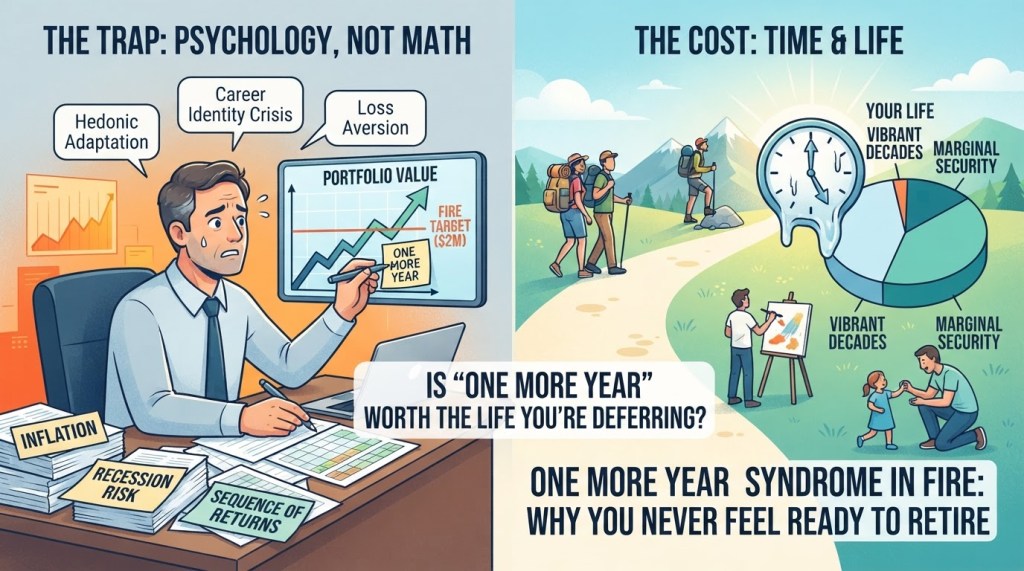
1. Hedonic Adaptation of the Goalpost
When you first set your FIRE number, it felt enormous. Reaching it seemed like it would fundamentally change your life. But as you approach the target, something strange happens: the number starts to feel ordinary. Your brain recalibrates. What once seemed like generational wealth now looks like “just enough to be safe”.
This is hedonic adaptation — the same mechanism that makes a raise feel normal within six months — applied to your net worth. The goalpost doesn’t move because the math changed. It moves because you changed. Your reference point shifted upward, and the number that once felt liberating now feels merely adequate.
So you add another year. Then another. Each one feels rational in isolation. None of them feel sufficient in retrospect.
2. Identity Fusion With Your Career
For high earners, professional identity and self-worth are often deeply entangled. You’re not just someone who works in tech, finance, or medicine — you are a senior engineer, a managing director, a specialist. Your title is shorthand for who you are at dinner parties, in your social circle, and in your own internal narrative.
Retirement, even early retirement, threatens that identity. The question “So what do you do?” becomes harder to answer. The structure, status, and sense of purpose that your career provides don’t disappear from your portfolio when you hit your number. They vanish from your daily life the moment you stop showing up.
One more year becomes a way of postponing that identity reckoning. It’s not about the money. It’s about the mirror.
3. Loss Aversion Disguised as Prudence
Humans feel losses roughly twice as intensely as equivalent gains. In the context of FIRE, this means the perceived risk of retiring “too early” feels far more threatening than the opportunity cost of working “too long”. Your brain frames the decision asymmetrically: if you retire and the market crashes, you’re ruined; if you keep working and the market booms, you’re merely richer than you needed to be.
This loss aversion makes caution feel like wisdom. Every new risk you identify — sequence of returns, healthcare inflation, a potential recession — feels like proof that you’re not ready yet. And because there will always be a new risk on the horizon, there will always be a reason to wait.
Prudence is valuable. But when prudence becomes a permanent state rather than a temporary strategy, it’s no longer protecting you. It’s imprisoning you.
The Compounding Cost of “Just One More”
The irony of OMY is that the extra year you’re buying is more expensive than you think — and not in the way your spreadsheet suggests.
The time cost is irreversible. A year of your life in your late thirties or early forties is not the same as a year in your sixties. The energy, health, and curiosity you have now are non-renewable resources. Every year you defer freedom is a year you spend trading your most vibrant decades for marginal financial security you may never need.
The health cost is real and measurable. Chronic stress, sedentary desk work, and the low-grade burnout of a career you’ve outgrown take a cumulative toll on your body. Your VO2 max declines. Your sleep quality erodes. Your cortisol baseline creeps upward. The “one more year” you’re working to fund a longer life may be quietly shortening the healthy portion of it.
The opportunity cost is invisible but enormous. Every year spent in OMY is a year you’re not traveling while your knees still work, not building the creative project you keep deferring, not spending unstructured time with aging parents or young children. These windows don’t stay open forever, and no amount of portfolio growth can reopen them once they close.
The extra $80,000 in your brokerage account will barely register in a thirty-year retirement. The missed year with your kids when they were seven will register forever.
Why Your Number Will Never Feel Safe Enough
Here’s the uncomfortable truth that OMY forces you to confront: there is no number that eliminates uncertainty.
You can model a 3% withdrawal rate instead of 4%. You can add a cash buffer of three years of expenses. You can diversify across geographies, asset classes, and currencies. And you will still find a scenario — a black swan event, a healthcare catastrophe, a prolonged bear market — that makes your plan look fragile.
This isn’t a flaw in your planning. It’s a feature of reality. The future is inherently unknowable, and any financial plan is a bet on probabilities, not a guarantee. If your standard for retirement is “zero risk,” you will never retire. The goalpost isn’t just moving — it’s accelerating.
The shift you need to make is from asking “Is my number big enough to survive the worst case?” to asking “Is my number big enough to handle the most likely cases with enough slack to adapt?” That’s a fundamentally different question, and it has a fundamentally different answer.
How to Break the Cycle: A Practical Framework
Recognizing OMY is the first step. Breaking it requires deliberate action. Here’s a framework that addresses the psychology, not just the portfolio.
Define “Enough” before you Hit it
The most important financial decision in your FIRE journey should be made when you’re calm, not when you’re standing at the finish line with adrenaline in your veins. Write down your number, your withdrawal rate, and your definition of “enough” now, while the goal is still distant. When you reach that number later, hold yourself to the version of you that wasn’t already adapting to a higher baseline.
Run the “Worst Realistic Case” Audit
Instead of stress-testing against every conceivable catastrophe, identify the three most probable risks to your plan — a 30% market drawdown in your first two years, a healthcare expense spike, a period of higher-than-expected inflation — and model those specifically. If your plan survives those scenarios with minor adjustments, you have enough. The tail risks beyond that are real but unmanageable through saving alone. They require flexibility, not more capital.
Prototype Retirement Before Committing
You don’t have to make the leap in a single bound. Take a sabbatical. Negotiate a three-month leave. Work part-time for a quarter. Use that time to test what your post-FIRE life actually feels like — the structure, the identity shift, the daily rhythm. Most people who prototype retirement discover that the fear was larger than the reality, and the transition becomes a choice rather than a cliff.
Separate Identity From Income
This is the hardest step and the most important. Start building the life you want in retirement before you retire. Develop hobbies, relationships, creative projects, and community ties that have nothing to do with your job title. The more your identity is distributed across multiple roles — reader, traveler, athlete, friend, creator — the less threatening the loss of your professional identity becomes. Retirement stops feeling like an ending and starts feeling like a reallocation of attention.
The Real Question isn’t “Do I Have Enough?”
One More Year Syndrome thrives on a question that can never be fully answered. As long as you’re asking whether your portfolio is large enough, you’ll always find a reason it isn’t.
The more useful question is: what am I sacrificing right now for a margin of safety I may never need?
Financial independence was never about accumulating the maximum possible number. It was about building enough slack to make choices freely — to walk away from work that drains you, to spend time on what matters, to design a life that doesn’t require an escape plan. If you’ve reached the point where the math works but you can’t pull the trigger, the problem isn’t your portfolio. It’s your relationship with certainty.
The number will never feel big enough. The year will never feel like the right one. The risk will never fully disappear.
At some point, you have to decide that the life you’re deferring is worth more than the safety you’re chasing. And that decision, unlike your portfolio, doesn’t compound with time. It depreciates.
Don’t let one more year become five more years. The freedom you’ve been building is already here. The only thing standing between you and the life you planned is the permission you keep refusing to give yourself.
Related Reading
- Escaping Golden Handcuffs: When to Pivot to FIRE
- The Freedom Gap: Why Hitting Your Number Doesn’t Feel Like Freedom
- Halfway to FIRE: Why the First 50% Is Harder Than the Second
- Why Financial Independence Is Really About Slack (Not Early Retirement)
- The Psychology of Enough: How to Redefine Wealth Beyond Money
- Life After Financial Independence: How to Navigate the Identity Crisis When Work No Longer Defines You
- The Boring Middle of FIRE: How to Stay Consistent While Compounding Works
- Why FIRE Isn’t Sustainable Without Financial Slack


Leave a comment