Imagine the scenario: You spent twelve years tracking every dollar, maximizing tax-advantaged accounts, and driving a paid-off car while your peers upgraded to luxury SUVs. You finally hit your “magic number”—say, $1.25 million—handed in your two-week notice, and booked a one-way flight to southern Portugal.
Then, the floor falls out.
A geopolitical shock, runaway inflation, or systemic credit crunch triggers a brutal, relentless bear market. Over the course of six months, the S&P 500 sheds 30%. Your $1.25 million portfolio shrinks to $875,000.
Your chest tightens. Your spreadsheet looks broken. The instinctual reaction is pure, cold panic: Cancel the flight, call your old boss, beg for your job back, and lock yourself into another five years of corporate cubicle life.
This is the nightmare scenario whispered about in every personal finance forum: retiring directly into a market crash. But while a 30% drop right at the starting line is undeniably stressful, it does not automatically mean your early retirement is doomed. In fact, if you understand the actual mechanics of sequence risk, portfolio valuation, and dynamic spending, retiring into or right after a bear market can actually be safer than retiring at the euphoric peak of an overextended bull market.
Here is the exact playbook for navigating early retirement when your portfolio takes a massive hit out of the gate.
The True Enemy: Sequence of Returns Risk
To survive a market crash at the start of retirement, you must first understand the specific monster you are fighting. It is not the market drop itself; it is Sequence of Returns Risk (SRR).
When you are in the wealth accumulation phase, market crashes are a gift. Every paycheck buys more index fund shares at a discount. A 30% drop just supercharges your long-term compounding.
When you transition to the decumulation phase, the math flips upside down. If you need to withdraw $50,000 a year to live, and your portfolio drops from $1,250,000 to $875,000, your effective withdrawal rate instantly spikes from a safe 4.0% to a precarious 5.7%.
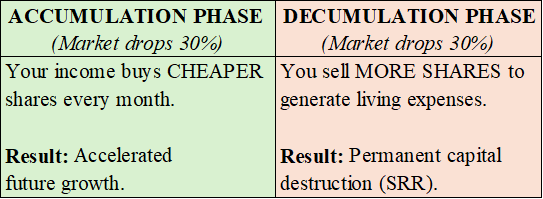
The danger is not just that your portfolio is down on paper; the danger is liquidating depressed assets to pay for groceries. When you sell equities that have dropped 30%, you permanently lock in those losses. Those liquidated shares are gone forever—they can never participate in the eventual market recovery. If this continues for two or three consecutive years, your portfolio balance is cannibalized so severely that it may never recover, even when the broader market rebounds to new all-time highs.
Research from financial planner Michael Kitces shows that the success or failure of a 30- to 40-year retirement is almost entirely determined by the returns you experience in the first 5 to 7 years. If you survive that initial window without cannibalizing your core equity shares, your portfolio will almost certainly survive forever.
The Counter-Intuitive Truth About Retiring After a Crash
Here is the paradox that most early retirees miss: Retiring right after a 30% drop is mathematically far safer than retiring the day before a 30% drop.
When the stock market is trading at historic highs with elevated valuation metrics (like a Shiller Cyclically Adjusted Price-to-Earnings or CAPE ratio above 35), future 10-year expected returns are historically low. When you retire at the peak of a bull market, you are buying into an asset class that is expensive, stretched, and vulnerable to a massive drawdown. You feel rich because your account balance is high, but your risk of experiencing a negative sequence of returns is at its maximum.
Conversely, after the market has already fallen 30%, a massive amount of speculative air has been let out of the balloon. Corporate valuations are compressed, dividend yields are higher, and historical data shows that median 5- and 10-year forward real returns following a 30% drop are overwhelmingly positive.
| Market Condition | Trailing 10-Year Return | Forward 10-Year Expected Return | Sequence Risk |
|---|---|---|---|
| All-Time Peak (High CAPE) | Abnormally High | Low to Moderate | Extreme |
| After 30% Crash (Low CAPE) | Depressed / Negative | High (Mean Reversion) | Significantly Lower |
The danger lies in retiring at the peak with a rigid, fragile plan. If you are already standing in the wreckage of a 30% drawdown, the worst of the valuation reset has often already occurred. You aren’t stepping onto thin ice; you’re standing on the structural bottom.
The 5-Part Playbook: Surviving FIRE After a 30% Drop
If you are facing a massive market drop right at your retirement date, do not panic-sell into cash, and do not immediately abandon your freedom. Instead, execute this five-part operational framework.
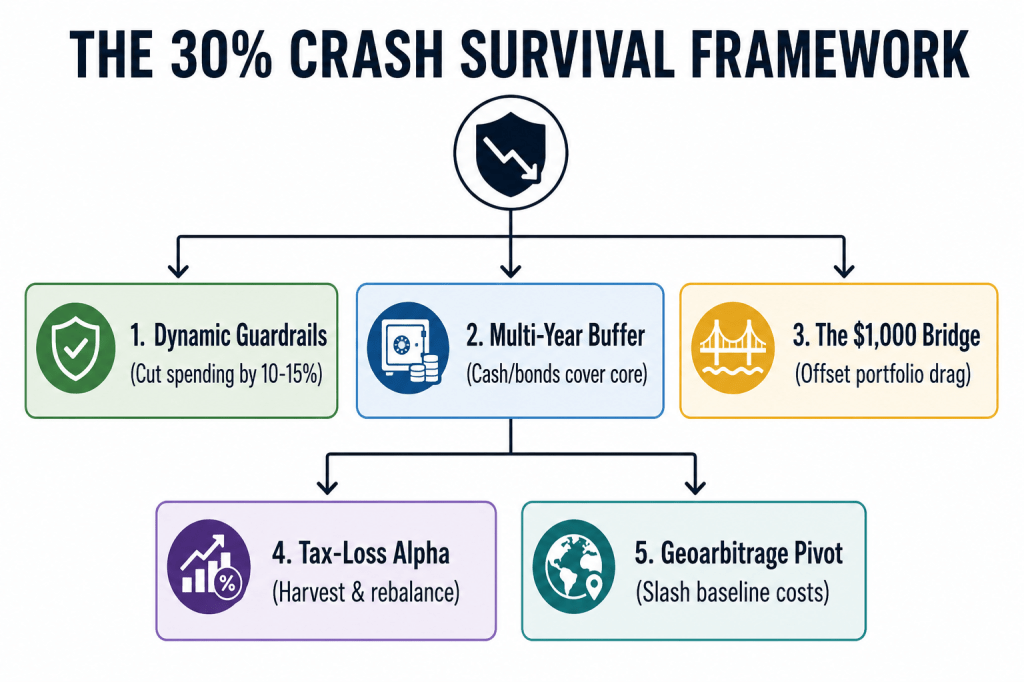
1. Shift Instantly from a Rigid 4% Rule to Dynamic Guardrails
The classic 4% rule (derived from the 1994 Trinity Study) assumes you blindly increase your spending every single year by inflation, regardless of what the stock market is doing. In the real world, no sentient human operates this way.
When your portfolio drops 30%, you must immediately switch to dynamic withdrawal guardrails (popularized by financial researcher Jonathan Guyton and William Klinger).
Instead of taking your scheduled inflation raise, apply three simple rules:
- Freeze the inflation adjustment: In a year where your portfolio drops significantly, do not adjust your withdrawal upward for inflation. Keep your nominal withdrawal flat.
- Implement a 10% capital preservation cut: If your current withdrawal rate exceeds your initial safe rate by more than 20% (e.g., your 4% target has climbed past 4.8% due to falling asset prices), reduce your baseline spending by 10% to 15% immediately.
- The “cut the fat, not the bone” principle: Most FIRE budgets include significant discretionary spending (international flights, dining out, new gear). Trimming 15% from your lifestyle for 18 to 24 months protects tens of thousands of dollars in underlying equity assets from liquidation.
Standard Rigid Spending:Year 1: $50,000 (Market drops 30%) ──> Year 2: $51,500 (Inflation raise) ──> [Portfolio Cannibalized]Dynamic Guardrails Spending:Year 1: $50,000 (Market drops 30%) ──> Year 2: $42,500 (15% discretionary cut) ──> [Equities Preserved]
A temporary 15% reduction in spending during the first two years of a crash reduces long-term portfolio failure rates back to near zero.
2. Activate Your Cash Buffer (The Non-Correlated Shield)
A well-constructed FIRE portfolio should never consist solely of 100% equities without an emergency buffer. If you followed a modern asset-allocation strategy, you should have 12 to 24 months of basic living expenses sitting in cash equivalents (High-Yield Savings Accounts, Money Market Funds, or short-term Treasury Bills).
Now is the precise moment to turn this buffer on.
When stocks drop 30%, halt all regular equity liquidations. Direct all dividends and interest payouts to your checking account, and draw the remainder of your living expenses directly out of your cash buffer.
Consider how this looks in practice for an early retiree with a $1,000,000 baseline target:
Total Portfolio at Peak: $1,000,000├── Equities (85%): $850,000 ──(Drops 30%)──> $595,000└── Cash / Short Treasuries (15%): $150,000 ──(Unchanged)──> $150,000Total Portfolio Post-Crash: $745,000
With $150,000 in cash and short-term paper, this retiree can fund a $40,000/year lifestyle for nearly four full years without selling a single share of depressed stock. By the time that cash reserve begins to run thin, historical market cycles indicate the equity market will have largely recovered, allowing them to resume regular rebalancing at normalized valuations.
3. Build an “Income Bridge” [The Barista FIRE (Financial Independence, Retire Early) Pivot]
One of the greatest mathematical fallacies of the early retirement community is the idea that FIRE must mean earning exactly $0 for the rest of your life.
During a 30% bear market, earning even a trivial amount of active income acts as an astonishingly powerful portfolio hedge.
Consider the math: If you need $4,000 a month to live, withdrawing that entire amount from a depressed $700,000 portfolio creates intense sequence risk. But if you pick up a low-stress consulting project, freelance writing, or part-time work at a local business that brings in just $1,500 per month, your required portfolio withdrawal drops from $4,000 to $2,500.
Monthly Need: $4,000───────────────────────────────────────────────────────────────────SCENARIO A (100% Portfolio Withdrawal):Withdraw $4,000/month from a depressed portfolio ($48,000/year = 6.8% withdrawal rate)SCENARIO B (Micro-Income Bridge):Earn $1,500/month activelyWithdraw $2,500/month from portfolio ($30,000/year = 4.2% withdrawal rate)───────────────────────────────────────────────────────────────────Difference: You just eliminated 38% of your sequence risk.
Generating $18,000 a year during a two-year downturn is the mathematical equivalent of having an extra $450,000 in your portfolio under a 4% withdrawal assumption. You don’t need to return to a 60-hour-a-week corporate job; you just need a low-friction bridge to take the pressure off your investments until the market regains momentum.
4. Aggressively Harvest Tax Losses and Rebalance
A market crash is not just a threat; it is a massive tax-optimization opportunity if you hold assets in taxable brokerage accounts.
- Tax-Loss Harvesting (TLH): Sell your broad-market index funds that are sitting at an unrealized loss (e.g., Vanguard Total Stock Market – VTSAX) and immediately swap them into a similar but non-substantially identical asset (e.g., Vanguard S&P 500 – VFIAX, or Schwab U.S. Broad Market – SCHB). This allows you to bank thousands of dollars in capital losses without being out of the market for a single trading day.
- Offsetting Future Income: You can use those harvested losses to offset up to $3,000 per year of ordinary income, while banking the remainder indefinitely to offset future capital gains when the market recovers.
- Opportunistic Roth Conversions: If your income has plummeted because you are no longer working, a bear market is the absolute best time to convert low-basis Traditional IRA funds into a Roth IRA. If you convert 1,000 shares of an index fund when it is priced at $70 instead of $100, you pay taxes on a $70,000 valuation. When the market recovers back to $100, that entire $30,000 rebound grows tax-free forever inside the Roth.
5. Execute Strategic Geoarbitrage
If your plan was to retire domestically and you suddenly find yourself with a 30% smaller nest egg, leverage the single greatest arbitrage available to the location-independent: geographic cost shifting.
Spending a year living in a lower-cost region – whether that is coastal Portugal, southern Spain, Southeast Asia, or Latin America – can reduce your baseline annual burn rate by 40% to 60% without compromising your quality of life.
Typical US Metro Burn Rate: $5,000 / month ($60,000/year)Slow-Travel European Burn Rate: $2,500 / month ($30,000/year)─────────────────────────────────────────────────────────────Annual Capital Preserved: $30,000 remaining in your portfolio
By spending the first 12 to 24 months of a bear market slow-traveling through lower-cost economies, you accomplish two critical objectives simultaneously: you fulfill the exploratory spirit of your early retirement, and you artificially crush your withdrawal rate down to ultra-safe territory while your investments recover back home.
The Psychological Battle: Paper Wealth vs. Unit Ownership
The hardest part of retiring into a bear market is rarely mathematical; it is emotional.
When you look at your investment dashboard and see that your portfolio has dropped from $1,200,000 to $840,000, your brain processes that decline as a direct loss of time and safety. You calculate that the $360,000 drop represents four years of your working life erased.
This is a cognitive error. You do not own a dollar figure; you own a fixed number of shares in productive global businesses.
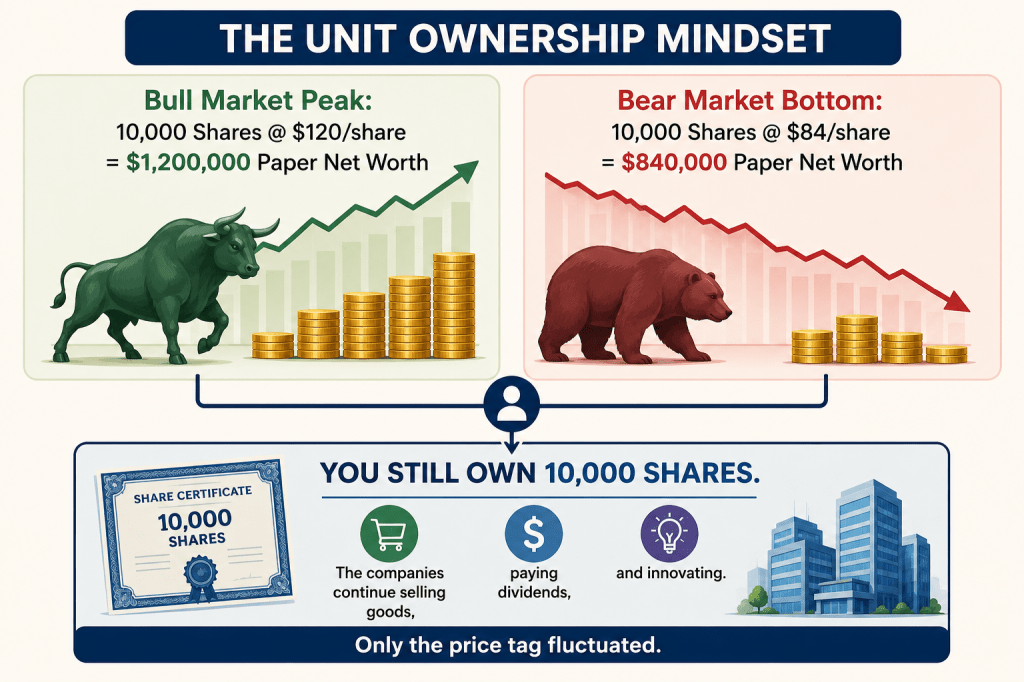
If you own 10,000 shares of a global index fund, you still own the exact same fraction of Microsoft, Apple, Nestlé, and Toyota after a 30% drop as you did before. Those companies did not lose 30% of their factories, patents, or workforce overnight. The market has simply marked down the liquidity price of those shares on that particular day.
As long as you do not sell your shares at those depressed prices, you have lost nothing real. The dividend yield continues to cashflow into your account, the underlying businesses continue to compound, and the price of the units will inevitably adjust upward over time.
The Bottom Line
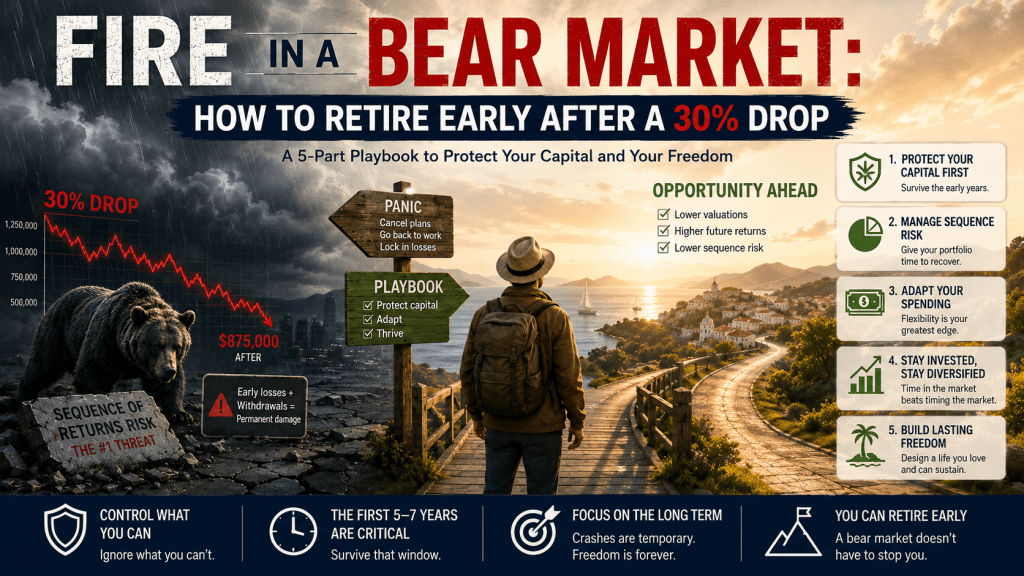
A 30% market drop right as you enter early retirement is a stress test, not a death sentence. The 4% rule was built on historical datasets that included the Great Depression, the stagflation crisis of the 1970s, the Dot-Com crash, and the 2008 Great Financial Crisis. It already assumes you will experience severe bear markets early in your retirement journey.
To make your FIRE plan bulletproof during a market crash:
- Never liquidate equities at the bottom. Rely on your cash buffer and incoming dividends.
- Compress your discretionary spending by 10% to 15% for the duration of the downturn.
- Earn a small amount of low-stress bridge income to neutralize the pressure on your portfolio.
- Use the crash to harvest tax losses and execute cheap Roth conversions.
- Remember that you own shares, not volatile paper numbers.
Financial independence is not a rigid mathematical formula that shatters the moment conditions change. It is a set of tools that gives you the flexibility to adapt. Execute the playbook, protect your equity base, and let compounding do the heavy lifting.
Related Reading
- Dynamic Withdrawal Rates for FIRE: Why Spending More Early Might Be Safer Than the 4% Rule
- Cash Buffer for FIRE: How Many Months of Expenses Do You Need?
- How to Make FIRE Bulletproof: The 3-Bucket System Most People Ignore
- Designing Cash Flow for Financial Independence (Not Maximum Returns)
- Why FIRE Isn’t Sustainable Without Financial Slack
- One More Year Syndrome in FIRE: Why You Never Feel Ready to Retire
- Semi-Retirement and FIRE: How Part-Time Work Speeds Up Financial Independence
- The Freedom Gap: Why Hitting Your Number Doesn’t Feel Like Freedom


Leave a Reply