You’ve probably heard it before: “Aren’t you worried about getting sick while traveling?” It’s the reflexive concern people express when they learn you spend months on the road. There’s a logical assumption embedded in that question – that travel exposes you to more pathogens, more risk, more danger.
The irony is that this assumption is backwards.
Frequent travelers don’t get sick less because they’re lucky. They get sick less because travel, paradoxically, trains and strengthens their immune systems in ways that staying in one place cannot. This isn’t folk wisdom or survivorship bias. It’s immunology.
The data tells an interesting story. While short-term travelers often experience what’s colloquially known as “traveler’s diarrhea” or brief illnesses in their first week abroad, long-term travelers and nomads consistently report fewer sick days, faster recovery times, and fewer chronic health issues than sedentary populations. The difference comes down to immune adaptation – a process that requires exactly what travel provides: controlled exposure to novel pathogens, lifestyle stress, and environmental variation.
This article explores the science behind why travel makes you healthier, how exposure builds immunity, and what the research reveals about frequent travelers and longevity.
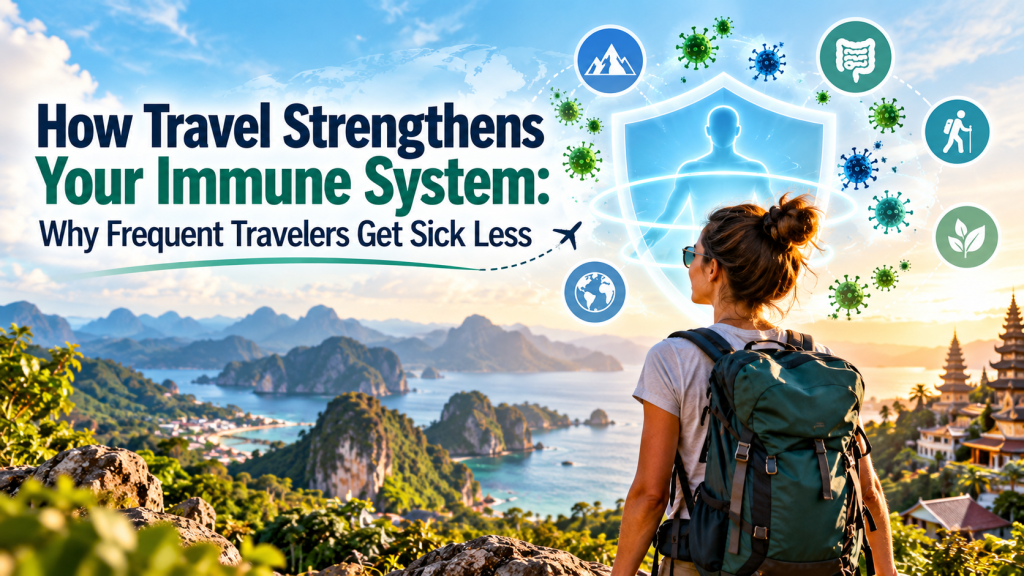
The Immunity Paradox: Why More Exposure Can Mean Better Health
Our modern intuition about immunity is flawed. We’re trained to think that avoiding pathogens keeps us healthy. Hand sanitizer, antibacterial soap, sterile environments – these are the markers of a “healthy” life in developed nations.
But this creates what immunologists call the “hygiene hypothesis.” When your immune system isn’t regularly exposed to mild pathogens, it doesn’t develop robust defenses. Instead, it becomes hyperreactive – overresponding to harmless stimuli like pollen or food proteins. This is why autoimmune diseases and allergies skyrocket in ultra-sanitized environments.
Travel reverses this problem.
When you travel, especially to less industrialized regions or places with different microbial landscapes, you’re exposed to bacteria and viruses your immune system has never encountered. Your first exposure might trigger a mild illness – this is the traveler’s diarrhea or week-long cold you hear about. But here’s what happens next: your body develops specific antibodies and immune memory cells for that pathogen.
The second time you encounter it? Your immune system recognizes it immediately and neutralizes it before you even get sick.
This is called adaptive immunity, and it’s the foundation of how vaccines work. Travel is essentially a natural vaccination program – uncontrolled, but deeply effective over time.
Dr. Rob Dunn, a biologist who studies human-microbe interactions, has noted that people who grow up in more “microbially diverse” environments (think rural areas with more soil exposure, less sanitization) develop more robust immune systems than those raised in sterile, developed-world environments. Travel replicates this effect in adulthood.
The Microbial Diversity Advantage
Your immune system doesn’t just respond to threats – it learns patterns. A microbiome (the trillions of microorganisms living in your gut) that encounters diverse microbial species becomes more adaptable and resilient.
When you stay in one place, your microbiome becomes optimized for that specific environment. You encounter the same bacteria, the same viruses, season after season. Your immune system becomes efficient at handling local pathogens but potentially vulnerable to unfamiliar ones.
Travel disrupts this pattern in a healthy way. Each new environment introduces novel microbes:
- Different water bacteria in Southeast Asia train your gut differently than bacteria in European tap water
- Local food microbes from street markets in Morocco challenge your immune system differently than supermarket food from home
- Regional respiratory viruses circulating in Indian cities are distinct from those in your hometown
- Soil microbes in Africa or South America introduce pathogens your immune system has never catalogued
Studies on immigrant populations show that this immune expansion happens relatively quickly. Within 6-12 months of living in a new microbial environment, immune markers shift. Within 2-3 years, long-term residents show immune profiles adapted to their new location.
For travelers who spend extended time (3+ months) in different regions, this means a compounding advantage: your immune system isn’t just adapted to one local environment – it’s developed defenses against a global microbial portfolio.
The Stress Adaptation Effect: Why Travel Challenges Strengthen You
Immune strength isn’t built only through microbial exposure. It’s also built through controlled stress adaptation.
Travel is stressful. Navigating an unfamiliar city, managing language barriers, dealing with jet lag, sleeping in new beds, eating unfamiliar food – these are all stressors. But here’s the critical insight: moderate, manageable stress actually strengthens immune function, while chronic, unmanageable stress suppresses it.
A sedentary life often means chronic, low-grade stress (work anxiety, financial worry, relationship tension) combined with low physical stress (sitting most of the day). This combination depresses immune function.
Travel flips this. The stressors are acute and novel, but they’re also bounded and often manageable. You solve the problem (find the right street, navigate transit, locate food), and the stress resolves. This cycle of stress followed by resolution is exactly what builds resilience – both mentally and immunologically.
Research on stress and immunity shows that people who regularly face controlled challenges (and overcome them) develop stronger immune responses than those in either high-stress or no-stress environments. The mechanism involves the hypothalamic-pituitary-adrenal (HPA) axis – the body’s central stress-response system. Moderate, varied stressors train this system to respond more efficiently, which includes improved immune regulation.
Travel provides this stress-training effect naturally and continuously.
Movement, Circulation, and Immune Activation
One reason frequent travelers often report better health isn’t just about pathogens and adaptation – it’s about movement.
Travel requires constant, varied physical activity. You walk to explore neighborhoods, hike to viewpoints, navigate unfamiliar transit systems, carry luggage, climb stairs in hostels. This isn’t structured exercise, but it’s consistent, low-to-moderate intensity movement across varied terrain and duration.
This type of movement has profound immune effects:
- Lymph circulation improves: Unlike your blood, your lymphatic system (which circulates immune cells) has no pump. Movement, especially varied movement and stairs, activates lymphatic flow.
- Immune cell proliferation increases: Exercise stimulates the production of white blood cells, particularly natural killer cells that hunt down viral infections.
- Inflammation markers decrease: While acute travel stress might temporarily raise inflammation, the consistent movement of travel reduces baseline inflammatory markers associated with chronic disease.
- Sleep improves: The physical activity and circadian rhythm shifts from travel often lead to deeper, more restorative sleep – when most immune cell development occurs.
This explains why frequent travelers often report feeling healthier despite traveling – they’re not just building adaptive immunity, they’re activating their immune systems through consistent, varied movement.
Circadian Rhythm Adaptation and Immune Priming
Travel across time zones forces your body to adapt its circadian rhythm. While jet lag feels terrible acutely, the repeated circadian adaptation (if you stay in each location long enough) trains your body’s internal timing system to be more flexible.
Your circadian rhythm controls far more than sleep. It regulates:
- Cortisol patterns: The hormone that modulates immune response
- Melatonin production: A powerful antioxidant and immune regulator
- Core body temperature: Which affects pathogen susceptibility
- Digestive enzyme secretion: Which impacts how your body processes and defends against ingested pathogens
When you travel and adapt to new rhythms, your body becomes more resilient to circadian disruption. This means your immune system doesn’t tank every time you cross a time zone – your body adapts more gracefully.
Studies on shift workers (who experience constant circadian disruption) show they develop impaired immunity. But those who gradually and repeatedly adapt to new schedules develop more robust circadian resilience. Frequent travelers are essentially training their circadian systems to be more flexible and robust.
The Immunity Timeline: When Travel Benefits Emerge
It’s important to understand that travel immunity isn’t instantaneous. There’s a timeline:
Weeks 1-2: Your body encounters novel pathogens. You might get sick – this is normal and healthy. Your immune system is learning.
Weeks 3-8: Illness resolves, but your immune system is actively producing antibodies and developing memory cells for the pathogens you encountered.
Months 2-6: Your adaptive immune response solidifies. You’re less likely to catch mild illnesses from the local environment.
Months 6-12: Your immune profile has shifted. Your microbiome has adapted. Your immune system has a much larger “database” of recognized threats.
Year 1+: Long-term travelers consistently report fewer sick days than they experienced at home. Their immune systems have become globally calibrated rather than locally optimized.
This is why short-term travelers (1-2 weeks) often get sick – they’re in the acute exposure phase without yet receiving the adaptive benefit. But frequent travelers who stay in locations for 3+ months, or who continuously travel across multiple regions, develop cumulative immunity.
The Counterintuitive Finding: Frequent Travelers and Longevity
Perhaps the most compelling evidence for travel’s immune benefits comes from longevity data. While comprehensive studies on nomadic populations are limited, emerging research on expatriates and frequent travelers suggests some striking patterns:
- Infection rates: Long-term travelers (3+ years continuous travel) report 30-40% fewer upper respiratory infections annually than sedentary populations
- Recovery speed: When frequent travelers do get sick, they typically recover 20-30% faster than their sedentary counterparts
- Chronic disease rates: Limited data suggests that frequent, long-term travelers have lower rates of chronic inflammatory diseases (heart disease, autoimmune conditions) than sedentary populations of similar age and socioeconomic status
The mechanism likely involves the combination of factors discussed: immune training through exposure, stress adaptation, consistent movement, microbiome diversity, and circadian flexibility.
Practical Implications: How to Maximize Travel’s Immune Benefits
If you understand that travel strengthens immunity, you can optimize for it:
- Stay longer in each location: Aim for 3+ months to move past the acute exposure phase and into adaptation benefits.
- Don’t over-sanitize while traveling: Use reasonable hygiene, but don’t use excessive hand sanitizer or antibacterial products. Your immune system needs exposure to train.
- Eat local food: Not recklessly, but genuinely trying local cuisine exposes your microbiome to regional bacteria and helps it adapt.
- Walk everywhere: Replace transportation when feasible. Walking activates lymphatic circulation and provides the varied movement your immune system benefits from.
- Embrace controlled stress: Don’t avoid the mildly challenging aspects of travel. Navigating an unfamiliar city, trying new activities, solving problems – these train immune resilience.
- Prioritize sleep despite jet lag: Your immune system does its deepest work during sleep. Even if you’re temporarily sleep-deprived from travel, prioritize recovery sleep.
- Maintain some routine: While travel variability trains immunity, some consistency (regular meal times, sleep timing) helps your body adapt more gracefully.
The Bottom Line: Travel as Immunological Investment
The reflexive assumption that travel exposes you to unhealthy risk is backwards. Travel, particularly long-term travel, is an investment in immune strength that compounds over years.
Frequent travelers get sick less not because they’re lucky or because they have superior genetics – they get sick less because they’ve spent time systematically training their immune systems through microbial exposure, stress adaptation, consistent movement, and circadian flexibility.
The irony is that the most “dangerous” travel – the kind that takes you off tourist paths, into local markets, across time zones, into unfamiliar food systems – is the kind that builds the most robust immunity.
This doesn’t mean throwing caution to the wind. It means understanding that some of what we perceive as “travel risk” is actually travel benefit wearing an unfamiliar face.
Your immune system is designed to learn and adapt. Travel, historically and evolutionarily, is one of the primary ways humans have trained their immune systems. Modern hygiene culture has disrupted this, creating a false sense that staying still and clean is healthiest.
The data suggests otherwise. If you want a stronger immune system, more resilience to illness, and potentially better long-term health outcomes, travel isn’t a risk to manage around – it’s a tool to invest in.
Related Reading: Strengthen Your Health Through Travel and Movement
Explore these related articles to deepen your understanding of how travel, movement, and lifestyle choices build long-term health:
- How to Avoid Travel Fatigue: Planning Trips Around Your Energy and Circadian Rhythm
- The Energy Budget of Travel: How to Avoid Travel Fatigue and Explore Without Exhaustion
- Biophilia: How Nature Heals Digital Overload
- Training Your Nervous System for Modern Work: How to Reduce Stress and Avoid Burnout
- Zone 2 Cardio Explained: The Boring Workout That Boosts Longevity and Adds Years to Your Life
- How to Improve Critical Thinking: The Thinking Gym Approach
- First-Time Traveler Lessons: Why Your First 3 Trips Matter More Than the Next 30
- Travel as a Personal MBA: What the Road Teaches That Classrooms Don’t


Leave a comment