You’re sitting at Gate B14. Your connecting flight is in seven hours. You’ve already checked the departure board four times, walked to the end of the terminal and back, and bought a coffee you didn’t want. Your phone is at 62%. You’re annoyed.
This is the universal experience of the long airport layover — that strange, suspended block of time that feels like a punishment inserted into your itinerary by a sadistic algorithm. Most travelers treat it as dead time. Something to endure. A gap to fill with overpriced sandwiches and anxious gate-watching.
I used to think the same way. Then I started paying attention to what actually happens during those hours when you stop fighting them.
Here’s the counterintuitive truth: your layover day might be the most valuable travel day of your entire trip. Not despite the boredom, but because of it. The long layover is one of the last genuinely liminal spaces in modern life — a threshold where you belong nowhere, owe nothing to anyone, and have zero obligations. And that kind of unstructured emptiness is rarer than you think.
Let me explain why most people waste it, and how to stop.
Why we hate Layovers (and why the Hatred is Misplaced)
The problem starts with how we measure travel. Most people evaluate a trip by its destinations: the temples, the beaches, the restaurants, the sunsets. Travel becomes a checklist, and every hour that doesn’t produce a photo-worthy moment feels like a failure.
A layover produces nothing. You’re not in the city you left. You’re not in the city you’re going to. You’re in a fluorescent-lit corridor between two places, surrounded by Cinnabon and duty-free perfume. By the logic of destination-based travel, it’s worthless.
But destination-based travel is the same logic that makes people sprint through Rome in 48 hours and call it “seeing Italy”. It’s the checklist mentality — the idea that travel is a collection of experiences to be acquired rather than a state of mind to be inhabited. (If you’ve read my piece on why travel in chapters works better than checklists, you already know where I stand on this.)
The layover exposes the flaw in that thinking more clearly than any other travel moment. Because when you strip away the destination, the landmark, and the Instagram opportunity, what’s left is just you, sitting in a chair, with time. And most of us are deeply uncomfortable with that.
We reach for our phones. We open our laptops and answer emails we could have ignored. We pace. We optimize. We try to turn the layover into a productive work session because the alternative — just sitting there — feels like laziness.
But the layover isn’t empty time. It’s unclaimed time. And there’s a massive difference.
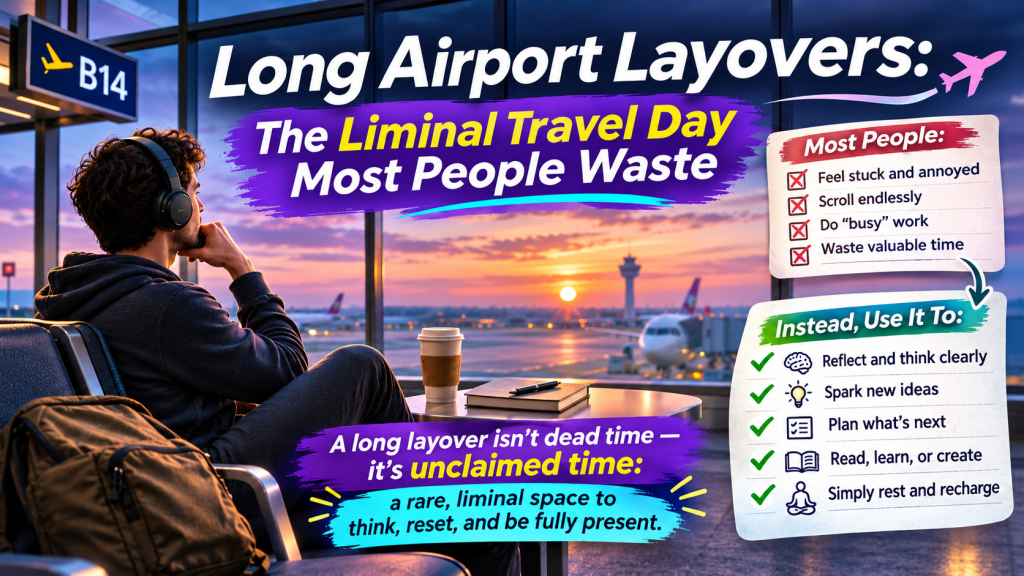
The Liminal Space Advantage
“Liminal” comes from the Latin word limen, meaning threshold. A liminal space is the in-between zone — the hallway between two rooms, the moment after you’ve quit a job but before you’ve started the next one, the foggy hour between waking and full consciousness.
Airports are the ultimate liminal space. You’ve physically left one place but haven’t arrived at the next. Your old context has dissolved; your new one hasn’t formed yet. You are, for a few hours, nobody in particular, nowhere in particular, with nothing in particular to do.
This sounds unpleasant. In practice, it’s extraordinary.
Think about how rare this state is in your normal life. At home, every hour has a function: work, commute, exercise, cook, socialize, scroll. Even your vacations get scheduled within an inch of their lives — morning hike, afternoon museum, evening food tour. You’re always somewhere, always doing something, always performing a version of yourself that fits the context.
The layover strips all of that away. Nobody in the airport knows you. Nobody expects anything from you. Your social identity is temporarily suspended. You’re not a colleague, a partner, a friend, a tourist, or a local. You’re a body in a terminal, waiting.
And that suspension creates a cognitive opening that almost nothing else in modern life can replicate.
Neuroscience calls this the activation of the default mode network — the brain system that kicks in when you stop focusing on external tasks. It’s the network responsible for self-reflection, creative insight, memory consolidation, and future planning. It’s also the network that gets chronically suppressed by the constant stimulation of daily life.
A long layover, if you let it, is one of the few situations where the default mode network gets to run uninterrupted for hours. No notifications. No social obligations. No itinerary demanding your attention. Just you and the hum of the ventilation system.
That’s not dead time. That’s the most cognitively fertile time you’ll have all month.
What actually happens when you stop Fighting the Layover
I’ve observed a consistent pattern across dozens of long layovers, and it unfolds in three distinct phases.
Hour one is resistance. You land, find your gate, confirm the connection, and immediately feel the itch. You pull out your phone. You check email. You browse the shops. You calculate whether you have time to leave the airport (you don’t, not yet). Your brain is still running on the operating system of your previous destination, trying to maintain momentum in a space that offers none. This is the most uncomfortable phase, and it’s the one that makes people declare layovers “the worst”.
Hour two is the shift. Something quiet happens. The restlessness peaks and then breaks. You sit down — really sit down — and the noise in your head starts to settle. You notice the light coming through the terminal windows. You watch other travelers and wonder where they’re going. You pull out a book and actually read it instead of skimming. The anxiety about “wasting time” fades because you realize, viscerally, that there is nothing to waste. The flight will leave when it leaves. You cannot speed this up.
Hour three and beyond is where the magic lives. This is when the ideas come. The journal entry you’ve been meaning to write for three weeks suddenly flows. The decision you’ve been avoiding at home crystallizes in twenty minutes of staring at a runway. You have a conversation with a stranger at the charging station that reframes something you’ve been stuck on for months. You feel, for the first time in a long time, genuinely unhurried.
I’ve had more creative breakthroughs in airport terminals than in any co-working space I’ve ever rented. Not because airports are inspiring environments — they’re not — but because they force the one condition that creativity actually requires: unstructured, unpressured time with no exit ramp.
A Practical System for Long Layovers
Philosophy is nice, but you still need to eat and your back still hurts from the economy seat. Here’s the framework I use for any layover over four hours.
Phase 1: Decompress (Hours 1–2)
Your body just endured a flight. Don’t immediately try to be productive or reflective. Address the physical first.
- Eat real food. Skip the fast-food court if you can. Most international terminals have at least one sit-down restaurant with actual meals. Eat slowly. This is the one time nobody is rushing you.
- Move. Walk the full length of the terminal. Not to kill time, but to undo the damage of sitting in a metal tube for six hours. Your hips and lower back will thank you.
- Shower if possible. Many airports have shower facilities — either in lounges, in transit hotels, or as standalone pay-per-use services. A ten-minute hot shower after a long-haul flight resets your entire nervous system. It’s the single highest-ROI layover investment you can make.
Phase 2: Create (Hours 2–4)
Now that your body is settled, your brain is ready for the liminal work.
- Journal. Not a travel diary — a thinking journal. Write about the trip you just left, the one you’re heading to, or the decision you’ve been circling at home. The threshold space will surface things your normal routine suppresses.
- Read deeply. This is the perfect environment for the kind of slow, focused reading that’s impossible at home. No laundry, no Slack, no doorbell. Just you and the book.
- Think without a screen. Sit near a window. Watch the planes. Let your mind wander. Resist the urge to fill every quiet moment with input. The default mode network needs silence to do its work.
Phase 3: Explore (Hours 4+)
If your layover is long enough — typically eight hours or more — consider leaving the terminal.
- Check visa requirements in advance. Many countries offer transit visas or visa-free layover programs (Singapore, Istanbul, Seoul, and Doha are excellent for this). A six-hour city sprint can be one of the most memorable parts of your trip.
- If you stay airside, go deeper. Most people cluster near their gate. Walk to the other end of the terminal. Find the quiet corner. Locate the airport chapel, the rooftop garden, the observation deck. Every major airport has hidden spaces that 95% of travelers never see.
What NOT to Do
- Don’t work. I know the temptation is enormous. You have Wi-Fi, a laptop, and “wasted” hours. But working during a layover converts liminal space back into ordinary space. You’ll arrive at your destination mentally exhausted instead of mentally reset.
- Don’t doom-scroll. Social media is the default mode network’s kryptonite. It fills the cognitive gap with noise instead of letting insight emerge.
- Don’t camp at the gate three hours early. Unless boarding has started, sitting at the gate is the most anxiety-producing place in the airport. Move away. The departure board will update on your phone.
The Bigger Lesson: Travel isn’t the Destination, it’s the Threshold
Here’s what the layover actually teaches you, if you let it: the quality of your travel is determined not by where you go, but by how present you are while getting there.
If you can’t sit quietly in an airport terminal without reaching for your phone, you probably can’t sit quietly on a beach in Bali without reaching for your phone either. The destination changes. The restlessness doesn’t.
The long layover is a mirror. It shows you exactly how comfortable you are with stillness, with uncertainty, with the absence of a plan. And those are the same skills that determine whether your travel actually transforms you or just entertains you.
Slow travel, meaningful travel, travel that compounds into personal growth — all of it starts with the willingness to inhabit the in-between spaces instead of rushing through them. The night train is more interesting than the flight. The ferry crossing is more memorable than the bridge. And the layover, that supposedly wasted block of hours in a place that belongs to no country, might be the most honest travel experience you have all year.
So the next time your itinerary hands you a seven-hour layover, don’t groan. Don’t immediately look for the nearest lounge to open your laptop. Don’t treat it as a problem to solve.
Treat it as the rarest thing in modern travel: a day with absolutely nothing on the schedule, in a place where nobody knows your name, with nothing to do but think.
Most people waste that. You don’t have to.
Related Reading
If you enjoyed this piece, you might also like:
- Night Train Travel: Why Slow Journeys Beat Flights for Long-Term Trips
- Why Rest Days Are the Secret to Better Travel: How Doing Less Helps You Experience More
- How to Travel Light Mentally: Stop Stress & Overplanning
- Why Travel in Chapters Works Better Than Checklists
- The Energy Budget of Travel: How to Avoid Travel Fatigue and Explore Without Exhaustion
- Comfort-Optimized Travel: Simple Systems That Reduce Stress and Save Time
- How to Avoid Travel Fatigue: Planning Trips Around Your Energy and Circadian Rhythm
- Travel as a Personal MBA: What the Road Teaches That Classrooms Don’t
☕ Enjoyed This Post?
If this piece changed how you think about your next layover — or if it just made a six-hour wait in Doha feel a little less painful — consider supporting the blog.
I write these posts because I believe travel, health, reading, and financial independence are deeply interconnected, and I want to explore those connections in ways that actually help you live better.
If you find value in that, you can Buy Me a Coffee. It takes 30 seconds, costs less than that airport coffee you didn’t want, and directly supports more writing like this.
Thank you for reading — and safe travels, especially in the in-between. ✈️


Leave a Reply