I’m 280 pages into Arundhati Roy’s The God of Small Things, and I have a confession: I keep zoning out.
Not because the book is bad — it’s extraordinary, and I’ve read enough fiction over the last four years to know the difference. The problem is that Roy will spend an entire paragraph describing the quality of light falling through a window, or the precise color of a dress worn by a character I’ll encounter exactly once, and my brain starts screaming: I want the story. Tell me what happens next. I don’t care about the hemline.
And yet, three pages later, she’ll describe a small emotional detail so precisely that I have to put the book down and stare at the wall for a minute.
This push-pull — fascination and frustration in the same chapter, sometimes the same page — is what reading a genuinely difficult book actually feels like. Not a steady climb toward enlightenment, but an oscillation between “this is the most beautiful thing I’ve ever read” and “I am losing my mind”.
We’ve been trained to treat that oscillation as a problem. It’s not. It’s the point.
The Fluency Illusion
Cognitive psychologists have a term for what happens when you read something smoothly: the fluency illusion. When text flows easily, your brain mistakes the ease of processing for the depth of understanding. You finish a chapter, you feel like you learned something, but if someone asked you to explain the core argument an hour later, you’d struggle.
The opposite is also true, and this is where it gets interesting. When reading feels hard — when you have to pause, re-read, look up a word, or sit with a confusing passage — your brain is actually encoding the material more deeply. Psychologists call this “desirable difficulty”, a concept pioneered by Robert Bjork at UCLA. The friction you feel isn’t a sign that learning is failing. It’s a sign that learning is happening.
Think of it like exercise. A walk around the block is pleasant, but it doesn’t build muscle. The burn you feel during a heavy set of squats is the stimulus your body needs to adapt. Reading works the same way. The confusion, the mental effort, the moment where you realize you don’t actually understand what you just read — that’s the cognitive equivalent of progressive overload.
Easy books maintain your current thinking. Difficult books restructure it.
What “Difficult” actually means
Before we talk strategy, let’s get specific about what makes a book hard, because not all difficulty is created equal — and each type demands a different response.
Dense prose. The sentences are long, the vocabulary is unfamiliar, and the author writes like they’re being paid by the subordinate clause. This is a surface-level difficulty. It’s real, but it’s solvable with patience and a willingness to slow down.
Unfamiliar concepts. The writing might be clear, but the ideas are foreign to your existing mental models. You’re a software developer reading about evolutionary biology, or a historian picking up quantum mechanics for the first time. The difficulty here is conceptual, not linguistic. You don’t lack reading skill — you lack context.
Structural complexity. The book doesn’t follow a linear argument. It jumps between timelines, layers multiple perspectives, or builds its thesis through accumulation rather than exposition. Roy’s novel is a masterclass in this. It doesn’t follow the A-happens-then-B-then-C structure most fiction relies on. Instead, it loops backward and forward through time, revealing the consequences of events before showing you the events themselves. The first time through, you’re disoriented. The second time — and there will be a second time, because Roy demands rereading — the structure reveals itself as the entire point. The difficulty isn’t a flaw in the storytelling. It is the storytelling.
Emotional weight. Some books are hard not because of their prose or structure, but because of what they ask you to sit with. Toni Morrison, Primo Levi, Ocean Vuong — the difficulty is affective, and pushing through it too quickly is its own form of avoidance.
Knowing which type of difficulty you’re facing changes how you should approach the book. A dense philosophical text needs a different strategy than a structurally experimental novel.
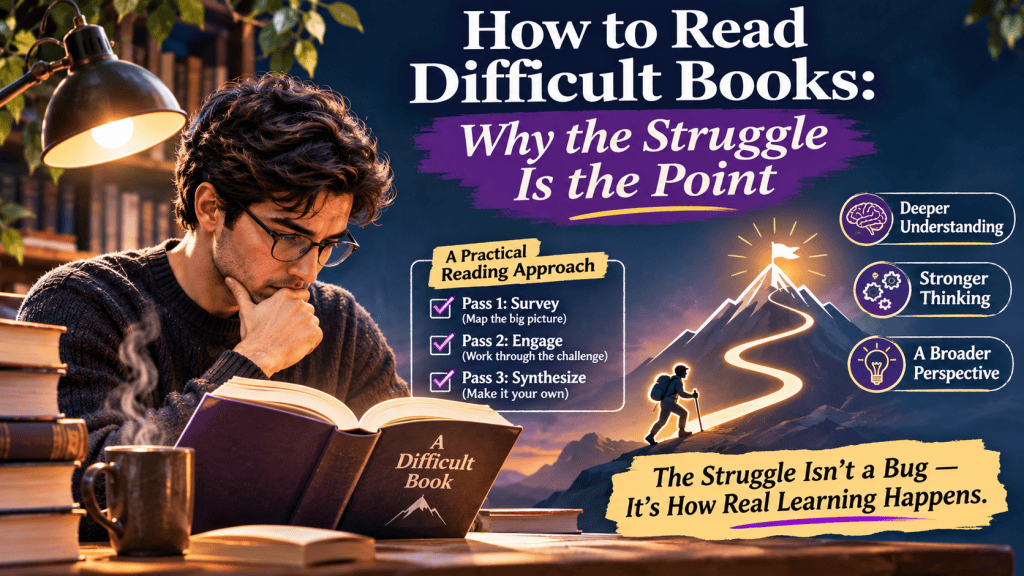
The 3-Pass Struggle Method
Here’s a practical framework for reading difficult books without burning out. It’s an adaptation of the multi-pass approach, but optimized specifically for material that resists easy comprehension.
Pass 1: The Survey (Read for Architecture)
Your first pass is not about understanding. It’s about mapping. Read the table of contents, the introduction, the chapter headings, and the conclusion. Skim the first and last paragraph of each chapter. Your goal is to answer one question: What is this book trying to do?
This takes 30–60 minutes for a typical non-fiction book, and it transforms the reading experience. When you know the destination, the confusing middle sections become less disorienting. You’re no longer wandering — you’re orienting.
Pass 2: The Argument (Read for Claims)
Now read the book properly, but with a specific filter: underline or note every major claim the author makes. Don’t worry about whether you agree. Don’t worry about whether you fully understand the supporting evidence yet. Just identify the load-bearing arguments.
During this pass, you will encounter passages you don’t understand. Here’s the key: don’t stop. Mark them with a question mark in the margin and keep moving. The context you need to understand that passage often appears three chapters later. Most readers quit because they treat every confusing paragraph as a roadblock. It’s not a roadblock — it’s a bookmark.
Pass 3: The Interrogation (Read Against the Text)
This is where the real cognitive rewiring happens. Go back to the passages you marked. Now read them slowly, and ask three questions:
- What is the author assuming here that they haven’t stated?
- Where do I disagree, and why?
- How does this connect to something I already know?
This pass is slow. It might take as long as the first two passes combined. But this is where difficult books earn their keep. You’re not just absorbing information — you’re building new connections between ideas, and that’s the mechanism through which reading actually changes your thinking.
Why Confusion is a Signal, not a Failure
When you encounter a concept you don’t understand, your brain enters what neuroscientists call a “prediction error” state. Your existing mental model made a prediction about what the next sentence would mean, and the text violated that prediction. This mismatch triggers the release of norepinephrine and acetylcholine — neurotransmitters that signal your brain to pay attention and encode new information.
In other words, confusion is literally the chemical trigger for learning. Without it, your brain stays in autopilot, reinforcing what it already knows. With it, your brain shifts into active construction mode, building new synaptic connections to accommodate the unfamiliar idea.
This is why re-reading a difficult passage five times is more valuable than reading five easy books once. The easy books never trigger the prediction error. They confirm your existing models. The difficult passage forces your brain to restructure.
There’s a trap here, though, and it’s worth naming: the “feeling of knowing”. When you read something and it clicks immediately, you experience a warm sense of comprehension. But that feeling is often illusory. Studies consistently show that people who report the highest confidence in their understanding after reading are frequently the worst at recalling the material later. The people who report feeling confused and uncertain often demonstrate the deepest retention.
The takeaway is counterintuitive but robust: if a book makes you feel smart, you probably didn’t learn much. If it makes you feel stupid, you’re probably growing.
When to Persist vs. When to Quit
A necessary caveat: not every difficult book deserves your struggle. There’s a critical difference between productive difficulty and pointless friction, and confusing the two is how readers burn out.
Persist when:
- The difficulty is conceptual (you lack context, not intelligence)
- The book is widely regarded as important in its field
- You feel confused but curious (not confused and bored)
- The confusion is specific (“I don’t understand this argument”) rather than global (“I have no idea what this book is about”)
Quit when:
- The difficulty is purely stylistic and the ideas underneath are thin
- You’re 100 pages in and the book hasn’t given you a single reason to keep going
- The author is obscure for the sake of obscurity, not precision
- You’re reading it for status, not genuine curiosity
I’ll use my own current read as an example. At page 280 of The God of Small Things, my feelings are genuinely mixed. The dress-color paragraphs still make me skim. But the moments of insight are so sharp, and the structural ambition so clear, that the fascination outweighs the frustration. I’m confused but curious — not confused and bored. That distinction is keeping me in the book, and it’s the same distinction I’d encourage you to apply to whatever difficult text is sitting on your nightstand right now.
The Long Game: How Difficult Books Compound
Here’s what nobody tells you about reading difficult books: the payoff is delayed, but it compounds.
The first time you read a challenging book, you might retain 10% of it. The second difficult book in the same genre, you’ll retain 25%, because the first book built a scaffolding of concepts you didn’t know you had. By the fifth book, you’re reading material that would have been impenetrable a year ago, and it feels merely challenging.
This is the intellectual equivalent of compound interest. Each difficult book makes the next one slightly more accessible, not because the books get easier, but because your cognitive infrastructure gets stronger. You develop what I think of as “conceptual stamina” — the ability to hold complex, unfamiliar ideas in your mind long enough to actually think about them, rather than reflexively reaching for a summary or a simpler alternative.
Over years, this compounds into something remarkable: a mind that can engage with complexity rather than flinch from it. In a world that increasingly rewards the ability to think clearly about hard problems, that’s not just a reading skill. It’s a life skill.
The next time you find yourself staring at a paragraph you’ve read three times without understanding, resist the urge to close the book. That confusion is not your enemy. It’s the feeling of your thinking expanding to accommodate something it couldn’t hold before. Stay with it. The struggle is the point.
📚 Related Reading
If this post resonated, you might enjoy these earlier pieces on reading better, thinking deeper, and getting more out of every book:
- How to Understand Any Book Better: The 3-Pass Reading System Explained
- Cognitive Friction: Why Some Books Change Your Thinking (and Others Don’t)
- When to Quit a Book: The 100-Page Rule Explained
- How to Read Critically: Why Disagreeing With Books Makes You a Smarter Reader
- Why Book Summaries Fail: The Truth About Reading Retention
- How to Read for Retention: Why Reading Too Fast is a Mistake
- Syntopical Reading: How to Master Any Subject with 5 Books
- Intellectual Cross-Training: The Benefits of Reading Outside Your Field
☕ Enjoyed This Post?
If this article helped you rethink how you approach difficult books, consider buying me a coffee. It takes real time and effort to research and write these pieces, and your support helps me keep publishing thoughtful, ad-free content on reading, health, travel, and financial independence. Every coffee counts — thank you for reading.


Leave a Reply