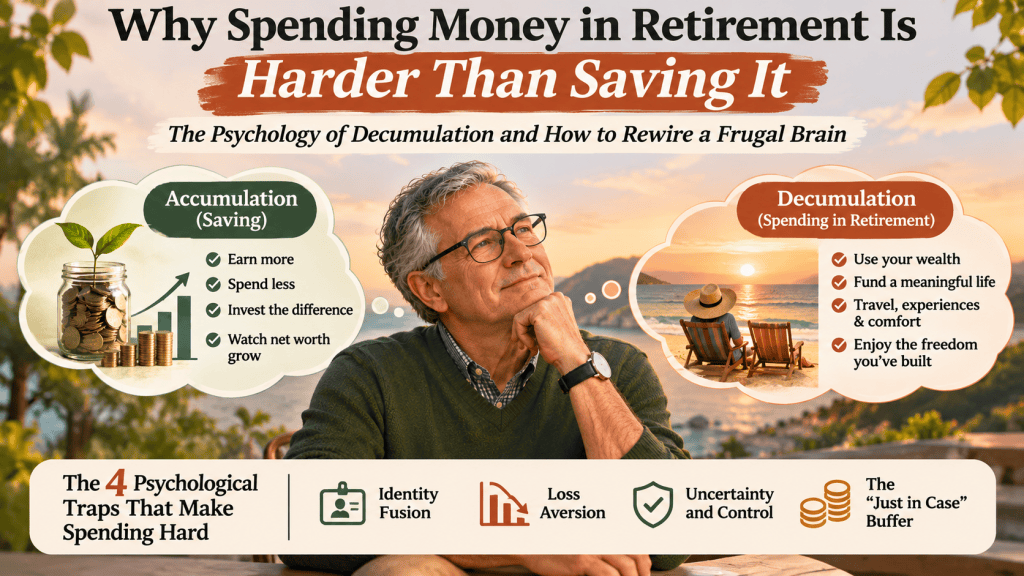
For the entire first half of your financial life, the rules of the game are simple: earn more, spend less, and invest the difference.
If you are pursuing Financial Independence, Retire Early (FIRE), you don’t just play this game — you master it. You optimize your savings rate, question every recurring subscription, drive older cars, cook at home, and learn to find genuine satisfaction in low-cost living. Every month, you watch your net worth tick upward. Every market dip is a buying opportunity. Every dollar saved is another brick in the wall of your future freedom.
Then, one day, you actually win. You hit your number.
You expect crossing the finish line to feel like taking off a heavy backpack after a decade-long hike. You imagine effortless mornings, guilt-free travel, and the quiet peace of knowing you never have to trade your time for a paycheck again.
Instead, something strange happens.
The first time you have to sell shares of your portfolio to pay for groceries or a flight, your stomach knots up. You look at the restaurant menu and still order the second-cheapest item. You hesitate before upgrading an uncomfortable mattress or booking the non-stop flight, even though your spreadsheets say you can afford it ten times over.
Welcome to the psychology of decumulation — the hidden second half of financial independence that almost nobody prepares for.
Accumulating wealth and spending down wealth are not simply the same math problem run in reverse. They require two completely opposite psychological operating systems. And if you don’t intentionally uninstall the mindset that got you to financial independence, it will quietly sabotage your ability to enjoy the life you worked so hard to build.
The Retirement Consumption Puzzle: Why Millionaires Live Like They’re Broke
Economists have a name for this phenomenon: the Retirement Consumption Puzzle (often paired with the Asset Decumulation Paradox).
According to traditional economic theory—specifically the Life-Cycle Hypothesis — humans should smooth their consumption over their lifetimes. We should save during our working years and systematically spend down our assets in retirement so that we use our wealth to fund a great life before we die.
In reality, the data shows the exact opposite.
Studies from the Employee Benefit Research Institute (EBRI) and BlackRock consistently find that most retirees — especially those with healthy portfolios — barely touch their principal. Nearly two decades into retirement, the vast majority of retirees still have more than 80% of their pre-retirement savings intact. Roughly a third actually watch their net worth grow larger in retirement because they refuse to spend their investment returns, let alone their principal.
In the FIRE community, this paradox is even more pronounced.
To retire in your 30s, 40s, or 50s requires an unusual degree of discipline, delayed gratification, and skepticism toward consumer culture. You don’t accidentally stumble into a 50% savings rate. You build it through years of repetition until frugality stops being a financial strategy and becomes a core personality trait.
When the day finally comes to flip the switch from saving to spending, your spreadsheet says “Go”, but your nervous system screams “Stop”.
Why Your Brain Rebels Against Decumulation: The 4 Psychological Traps
Why is it so difficult for smart, rational people who understand the 4% rule and Monte Carlo simulations to spend their own money? Because financial independence isn’t just a math problem — it’s a behavioral conditioning problem.
Here are the four psychological traps that make decumulation feel unnatural.
1. Identity Fusion: When Net Worth Becomes Self-Worth
When you spend ten or fifteen years pursuing FIRE, saving money becomes your primary feedback loop for competence.
Watching your net worth climb gives you a reliable hit of dopamine. A high savings rate becomes a badge of honor, a source of emotional security, and proof that you are in control of your life. Over time, your identity fuses with the act of accumulation. You are “the disciplined investor”, “the optimizer”, “the person who doesn’t waste money”.
In decumulation, the scoreboard reverses. By definition, living off your portfolio means watching your share count decline or your net worth fluctuate without new cash inflows to prop it up. To a brain wired to equate a rising net worth with safety and success, spending down your portfolio doesn’t feel like harvesting the crop you planted — it feels like failing.
2. Loss Aversion and the Disappearing Paycheck
Nobel laureate Daniel Kahneman demonstrated that human beings experience the pain of a loss roughly twice as intensely as the pleasure of an equivalent gain.
While you are working, your paycheck acts as a psychological shield. If you spend $3,000 on a vacation, you don’t feel like you are shrinking your life savings; you simply saved a little less from this month’s paycheck. Next month, the tank refills automatically.
The moment you retire, the faucet turns off. Every dollar you spend now has to come out of the reservoir you spent years filling.
Even if your portfolio grows by $8,000 in a given month and you withdraw $4,000, the act of manually selling assets triggers loss aversion. In your mind, you aren’t spending cash — you are killing the goose that lays the golden eggs, one feather at a time.
3. The Compounding Calculator You Can’t Turn Off
To reach FIRE early, you had to train your brain to see opportunity cost everywhere.
You learned a mental trick: a $100 dinner isn’t really $100; compounded at 7% real returns over 20 years, it’s nearly $400 of future freedom. That $30,000 car upgrade is actually $120,000 of lost retirement security.
That mental calculator was an incredible tool in your 20s and 30s. But in retirement, it becomes a curse. When you can’t turn off the compounding calculator, every discretionary purchase feels reckless. You forget that the entire point of compounding your money for decades was so that, eventually, now would become the future you were saving for.
4. The Phantom Threat of the Unknown
During the accumulation phase, if the market crashes by 30% or an unexpected medical bill arrives, you have a simple fallback: you still have a career. You can work an extra six months, pick up a project, or divert your next few paychecks into buying stocks on sale.
Once you leave the workforce — especially in early retirement, with a 40- to 50-year time horizon ahead of you — that safety net feels further away. You become hyper-aware of Sequence of Returns Risk, inflation spikes, healthcare costs, and unknown emergencies decades down the road.
Because the future is fundamentally uncertain, the frugal brain defaults to the only defense mechanism it knows: hoard more resources. If $1.5 million feels slightly vulnerable, maybe $2 million will feel safe. And when you hit $2 million, you wonder what happens if inflation surges, so you live as if you only have $1 million.
The Hidden Cost of Under-Spending: What Frugality Steals From You
At first glance, under-spending in retirement seems like a harmless problem. After all, nobody goes bankrupt by spending too little. If the worst-case scenario is that you leave a massive inheritance or donate millions to charity when you pass away, is decumulation anxiety really that bad?
Yes — because every dollar you refuse to spend out of irrational fear is paid for with a currency far scarcer than money: your healthspan.
We tend to think of retirement as a single, uniform block of time stretching from the day we quit work to the day we die. In reality, retirement is divided into distinct biological chapters:
- The Go-Go Years: High energy, physical resilience, sharp curiosity, and the mobility to travel, hike, learn new skills, and stay active.
- The Slow-Go Years: Energy tapers off, recovery takes longer, comfort matters more, and travel becomes simpler and closer to home.
- The No-Go Years: Life becomes deeply localized, quiet, and centered around health maintenance and immediate comfort.
Here is the brutal irony of the Retirement Consumption Puzzle: most retirees starve their Go-Go years to over-insure their No-Go years.
A dollar does not have constant utility across your lifespan. Spending $5,000 to trek through Patagonia, take your aging parents on a memorable trip, or spend a month living in a walkable European city at age 42 delivers a massive return on life. That same $5,000, compounded into $25,000 when you are 85 and unable to walk through an airport terminal, cannot buy that experience back.
When you let decumulation anxiety run your life, you end up making a terrible trade: you sacrifice your highest-vitality years to become the wealthiest person in the assisted living facility.
A Systems Approach to Decumulation: 5 Frameworks to Spend Without Fear
You cannot fix a deeply ingrained psychological habit by simply telling yourself to “relax and enjoy your money”. Just as you used systems to automate your savings during the accumulation phase, you need systems to automate and de-risk your spending during the decumulation phase.
Here are five practical frameworks to help you transition from wealth builder to wealth user.
1. Build a “Synthetic Paycheck” (Never Sell Stocks for Groceries)
The single biggest trigger for spending anxiety in retirement is linking everyday consumption to portfolio liquidation. If you have to log into your brokerage account and sell shares of an index fund to pay for a flight or a home repair, every purchase will feel painful.
Instead, create structural separation between your volatile investments and your daily life using a Cash Buffer / Bucket System:
- Keep 18 to 36 months of living expenses in a high-yield savings account, money market fund, or short-term Treasury ladder.
- Set up an automated monthly transfer on the 1st of every month from this cash reserve into your everyday checking account.
- Rebalance and refill the cash bucket from your investment portfolio only once or twice a year, on a predetermined schedule.
To your brain, this feels identical to receiving a salary. You are no longer “spending down your life savings” when you buy dinner; you are simply spending this month’s paycheck, knowing the next two years of paychecks are already sitting safely in cash.
2. Replace the Rigid 4% Rule with Dynamic Guardrails
Much of the fear around spending comes from treating retirement withdrawals as a pass/fail cliff. If you view the 4% rule as static, you constantly worry about whether you are on the 5% of historical timelines that fail.
Switch to a Dynamic Withdrawal Framework (such as the Guyton-Klinger guardrails or a Floor-and-Ceiling system).
- Define your Baseline Floor: What does your life cost covering pure essentials (housing, nutritious food, healthcare, basic utilities)? Most FIRE practitioners discover their true survival floor is 30–40% lower than their target retirement budget.
- Define your Discretionary Upside: Travel, dining out, upgrades, hobbies, and generosity.
When you realize that in a severe bear market, you don’t actually run out of money — you simply trim 15% of your discretionary travel budget for a year or two while your cash buffer absorbs the shock — the existential fear of going broke evaporates. Flexibility is a far better safety net than hoarding.
3. Create a Mandatory “Sinking Fund for Joy”
If you leave discretionary spending in the same mental bucket as your utilities and taxes, your frugal conditioning will always try to optimize it down to zero.
To break this habit, establish a separate account specifically for Lifestyle Expansion & Guilt-Free Spending. Fund it at the beginning of each year with a small percentage of your portfolio (even 0.5% to 1% when your portfolio is up).
Set one non-negotiable rule for this account: Any money left inside it on December 31st is automatically donated to a charity — or a political cause you dislike.
Once the money is already “spent” out of your net worth on January 1st, the friction disappears. Your brain shifts from asking, “Should I spend this money?” to “How can I get the highest return on experience from this budget before the year ends?”
4. Practice “Progressive Overload” on Your Spending Muscle
In strength training, if you haven’t lifted weights in years, you don’t walk into the gym and load 300 pounds onto the bar. You start with a weight that feels slightly uncomfortable and gradually increase the load as your nervous system adapts.
Treat spending the same way. If you have been hyper-frugal for a decade, booking a $10,000 luxury trip will trigger a financial panic attack, and you won’t enjoy it anyway. Instead, practice small, deliberate upgrades that buy back time, health, or comfort:
- Stop sorting flight searches by “Cheapest” and start sorting by “Best Schedule / Direct”.
- Buy the highest-quality groceries without checking whether the berries are in season or on sale.
- Hire out a household chore you genuinely dislike.
- Pick up the check when having coffee or dinner with a close friend.
Notice that after each small upgrade, the sky doesn’t fall. Your portfolio barely notices. Over time, your nervous system recalibrates to the reality that you are financially safe.
5. Change Your Scorecard: From Net Worth to “Return on Life”
What you measure is what you optimize.
During the path to FIRE, checking your net worth spreadsheet once a month was healthy. In retirement, checking your portfolio daily or weekly is toxic. It chains your mood to random stock market noise over which you have zero control.
If you want to stop obsessing over decumulation, give your analytical mind a better set of metrics to track:
- Healthspan Biomarkers: VO2 max, resting heart rate, sleep quality, grip strength, and days spent moving outdoors.
- Time Quality: Unscheduled mornings per month, hours spent in deep reading or creative flow, and days free of digital clutter.
- Relationship Depth: Meals shared with people you love, trips taken with family while everyone is still healthy, and moments of generosity.
When you measure your life by these numbers, hoarding an extra 2% in your brokerage account at the cost of a meaningful experience stops looking like discipline — and starts looking like bad math.
Final Thought: Money is Stored Energy, Not a High Score
There is an old saying that a ship is safest in the harbor, but that is not what ships are built for.
Your portfolio is the same. A pile of index funds sitting untouched in a brokerage account has no intrinsic value. It is simply stored energy — crystallized time, discipline, and effort from your younger self, waiting to be converted into freedom, health, curiosity, and connection.
The transition from saving to spending won’t happen overnight. Decades of frugal conditioning take patience to unwind. Be gentle with yourself when you still feel a pang of guilt over an expensive meal or a dip in the market.
Remind yourself why you started this journey in the first place. The goal of financial independence was never to die with the highest number on a screen. The goal was to build a life so rich in meaning, autonomy, and experience that you eventually stop thinking about money altogether.
☕ Enjoyed this post?
If this essay gave you a useful framework or helped shift how you think about money and freedom, consider supporting my writing! I publish deep dives on FIRE, longevity, deliberate reading, and slow travel without ads or paywalls.
👉 Buy Me a Coffee here — your support keeps the coffee flowing and the ideas compounding.
📚 Related Reading from the Archive
If you resonated with this piece, dive into these related essays next:
- The Freedom Gap: Why Hitting Your FIRE Number Doesn’t Feel Like Freedom
- How to Overcome the Fear of Spending Money: A Mindset Shift
- The Second-Order Effects of Frugality: When Saving Money Starts to Cost You
- Sequence of Returns Risk in FIRE: Why the First 5 Years of Retirement Matter More Than the Last 20
- Dynamic Withdrawal Rates for FIRE: Why Spending More Early Might Be Safer Than the 4% Rule
- How to Make FIRE Bulletproof: The 3-Bucket System Most People Ignore
- Early Retirement Regrets: What FIRE Retirees Wish They Knew
- Healthspan vs Lifespan: How to Live Better, Not Just Longer


Leave a Reply