Imagine two people. Both retire at 45 with a $1.5 million portfolio. Both earn an average annual return of 7% over the next 30 years. Both withdraw $60,000 a year, adjusted for inflation.
One dies broke at 72. The other dies with $4 million at 85.
Same starting balance. Same average return. Same withdrawal rate. Completely opposite outcomes.
The only difference? The order in which those returns showed up.
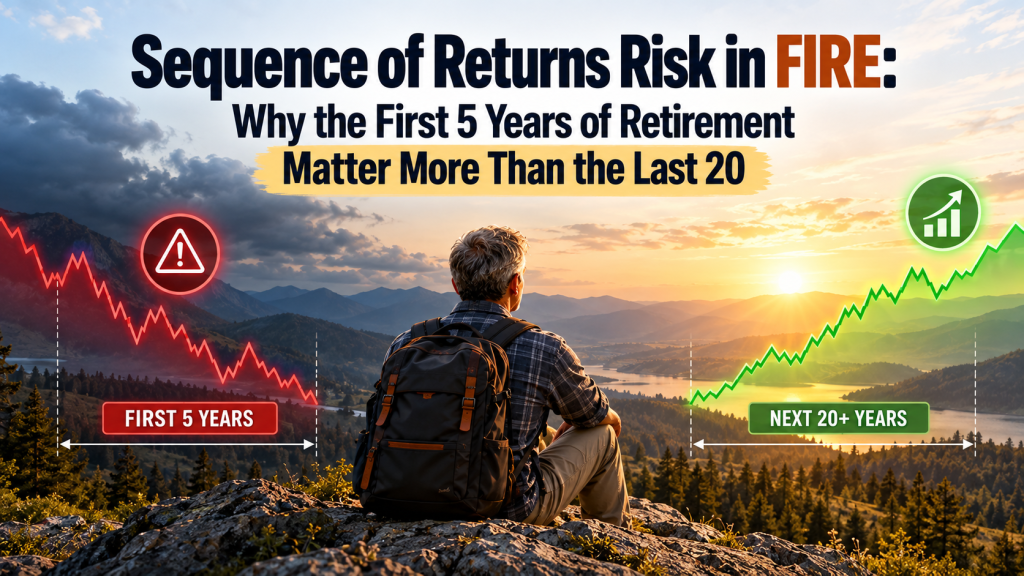
This is sequence of returns risk (SORR), and it is the single greatest threat to your early retirement plan — far more dangerous than inflation, healthcare costs, or even a prolonged bear market. And the cruel math behind it means the damage is almost entirely front-loaded. The first five years of your retirement will determine whether your portfolio survives the next twenty-five.
If you’re within striking distance of your FIRE number, this is the most important concept you haven’t stress-tested yet.
What Sequence of Returns Risk Actually Means
Most FIRE (Financial Independence, Retire Early) planning relies on averages. You plug a 7% return into a spreadsheet, assume a 4% withdrawal rate, and watch your portfolio grow in a smooth upward line for thirty years. The math works beautifully — on paper.
But markets don’t deliver averages in neat annual installments. They deliver chaos. You might get +22%, then -18%, then +4%, then +31%, then -12%. The average across those five years might be 7%, but the sequence in which those returns arrive changes everything when you’re simultaneously pulling money out.
Here’s the simplified version. Say you start with $1 million and withdraw $40,000 in Year 1.
Scenario A (Good sequence): Your portfolio returns +20% in Year 1. Your balance grows to $1.16 million after your withdrawal. You now have a bigger base compounding forward. Even if Year 2 brings a -15% crash, you’re recovering from a higher peak.
Scenario B (Bad sequence): Your portfolio drops -20% in Year 1. After your withdrawal, your balance falls to $760,000. Now you need a much larger percentage gain just to get back to where you started. And you’re still withdrawing $40,000 from a shrinking base every year.
The returns are identical. The outcomes are not. When withdrawals collide with early losses, you create a compounding problem in reverse — a “withdrawal drag” that becomes nearly impossible to recover from.
Why the First 5 Years Are Disproportionately Dangerous
The reason the danger concentrates in the early years comes down to portfolio size and mathematical leverage.
In Year 1 of retirement, your portfolio is at its largest. A 30% drop on $1.5 million destroys $450,000 of capital — money that would have been compounding for decades. Worse, you’re still withdrawing your full living expenses from the wreckage. You’re selling more shares at lower prices to fund the same lifestyle, which locks in permanent losses. This is sometimes called the “reverse dollar-cost averaging” problem, and it’s the exact opposite of the accumulation strategy that built your wealth in the first place.
By Year 20, the dynamics have shifted entirely. If your portfolio survived the early gauntlet, it has likely grown substantially through compounding. A 30% drop on a $3 million portfolio is painful, but your withdrawal rate relative to the total balance is now much smaller. You’re pulling 2% instead of 4%. The portfolio can absorb the shock without structural damage.
Research from Vanguard and the Trinity Study authors consistently shows that the sequence of returns in the first five to ten years of retirement explains roughly 80% of the variance in long-term portfolio survival. The returns in Years 20 through 30 barely move the needle. By then, the die has already been cast.
Think of it like launching a rocket. The first few minutes of flight consume the most fuel and carry the highest risk of catastrophic failure. Once you reach orbit, the physics become forgiving. Your FIRE portfolio follows the same trajectory.
A Real-World Tale of Two Retirees
The most vivid illustration of SORR comes from the dot-com era.
Retiree A retired in January 2000 with $1.5 million in a 60/40 stock-bond portfolio, withdrawing 4% annually. The S&P 500 dropped 9% in 2000, 12% in 2001, and 22% in 2002. Three consecutive years of withdrawals from a collapsing portfolio. By 2003, their balance had cratered to roughly $950,000 — a 37% drawdown in real terms. Even though the market eventually recovered and delivered strong returns through the 2010s, the early damage was irreversible. Their portfolio never fully caught up to the withdrawal curve.
Retiree B retired in January 2010 with the same $1.5 million and the same 4% withdrawal. They walked into a decade-long bull market. By 2015, their portfolio had grown to over $2 million despite five years of withdrawals. The 2020 pandemic crash barely registered because their balance was large enough to absorb it.
Same plan. Same discipline. Radically different outcomes — entirely determined by the luck of their start date.
Why the Last 20 Years Matter Far Less
There are three structural reasons the tail end of retirement carries minimal sequence risk.
First, your withdrawal rate shrinks relative to portfolio size. If your portfolio compounded successfully through the early danger zone, your $60,000 annual withdrawal might represent 2% or less of your total balance by Year 20. At that rate, even a severe bear market won’t threaten solvency.
Second, you’ve already survived the worst-case scenarios. The historical data shows that if a portfolio survives the first ten years of retirement without depleting below its starting value, the probability of lasting 30+ years jumps above 95%. The risk curve flattens dramatically.
Third, your spending tends to decline with age. Research from the Employee Benefit Research Institute shows that retiree spending drops 1–2% per year in real terms after age 70, as travel slows, housing costs stabilize, and discretionary spending contracts. Your portfolio faces less withdrawal pressure precisely when its growth rate may also be slowing.
The last 20 years of retirement are a coasting phase. The first five are a survival phase. Plan accordingly.
5 Practical Strategies to Neutralize Sequence Risk
You can’t control market timing. But you can build a retirement plan that doesn’t require you to.
1. Build a Cash Buffer of 2–3 Years of Expenses
This is the single most effective SORR mitigation tool. If you keep $120,000–$180,000 in cash or short-term treasuries, you never have to sell equities during a downturn. You fund your lifestyle from the cash buffer while your portfolio recovers. Once markets rebound, you refill the buffer. This simple move eliminates the “selling low” problem entirely during the most dangerous window.
2. Use Dynamic Withdrawal Rates Instead of a Fixed 4%
A rigid 4% rule assumes you’ll withdraw the same inflation-adjusted amount regardless of market conditions. A dynamic approach adjusts your spending based on portfolio performance. In down years, you cut withdrawals by 10–15%. In up years, you give yourself a raise. Research from Morningstar and Wade Pfau shows that flexible withdrawal strategies increase portfolio survival rates from 85% to over 97% across historical sequences. You already built a lean lifestyle to reach FIRE — flexing it by a few thousand dollars in a bad year is a small price for long-term security.
3. Deploy a Bond Tent
Popularized by Michael Kitces, the bond tent strategy involves holding a higher allocation of bonds in the five years before and five years after your retirement date. You might shift from 80/20 stocks/bonds to 60/40 as you approach your target, then gradually shift back to 70/30 or 80/20 by Year 10. The bond allocation acts as a shock absorber during the critical early window, reducing your maximum drawdown when it matters most.
4. Use a Three-Bucket System
Divide your portfolio into three time-horizon buckets. Bucket 1 holds 1–2 years of cash for immediate spending. Bucket 2 holds 3–7 years of bonds and conservative assets for medium-term stability. Bucket 3 holds equities for long-term growth. You spend from Bucket 1, refill it from Bucket 2, and let Bucket 3 compound untouched. This structure psychologically and mechanically prevents you from panic-selling equities during a crash.
5. Maintain Income Optionality
The most underrated SORR hedge isn’t a portfolio strategy — it’s a lifestyle one. If you can generate even $20,000–$30,000 a year from part-time work, freelancing, or a side project during the first five years, you dramatically reduce your withdrawal rate during the most vulnerable period. This is the core logic behind Barista FIRE and Coast FIRE. You don’t need a full-time career. You need enough income to avoid draining your portfolio during a bear market. Even modest earnings create an enormous mathematical advantage when your portfolio is most fragile.
The Mindset Shift: From Hitting the Number to Surviving the Sequence
Most of the FIRE community obsesses over the accumulation phase. How to save more, invest faster, and hit the target number. But reaching your number is only half the equation. The other half — the half nobody posts about on Reddit — is surviving the first five years of drawing it down.
Your FIRE number is not a finish line. It’s a launchpad. And the launch window is narrow, volatile, and largely outside your control.
The retirees who thrive long-term aren’t the ones who optimized every dollar on the way in. They’re the ones who built enough slack into their plan to absorb a terrible sequence on the way out. They held extra cash. They stayed flexible. They accepted that the first few years might require temporary compromises to protect decades of freedom.
The math is clear. The first five years of retirement carry more risk than the next twenty combined. Build your plan around that reality, and the rest takes care of itself.
Related Reading
- FIRE in a Bear Market: How to Retire Early After a 30% Drop
- Dynamic Withdrawal Rates for FIRE: Why Spending More Early Might Be Safer Than the 4% Rule
- Cash Buffer for FIRE: How Many Months of Expenses Do You Need?
- How to Make FIRE Bulletproof: The 3-Bucket System Most People Ignore
- Designing Cash Flow for Financial Independence (Not Maximum Returns)
- Why FIRE Isn’t Sustainable Without Financial Slack
- One More Year Syndrome in FIRE: Why You Never Feel Ready to Retire
- The 5 Stages of Financial Independence (And Where You Are Now)


Leave a comment