There’s a particular kind of guilt that lives in the audiobook listener’s psyche. You finish a book on your commute, feel the satisfaction of a completed narrative, and then a small voice whispers: but did you actually read it?
The assumption is deeply ingrained. Real readers read with their eyes. Audiobooks are the shortcut, the compromise, the thing you do when you “don’t have time to actually read.” And if you’ve spent any time in bookish corners of the internet, you’ve encountered the purists who will tell you — with genuine conviction — that listening to a book doesn’t count.
The science tells a more interesting story. One where the format you choose matters far less than what you’re reading, how you’re engaging with it, and when you’re consuming it. And in several specific situations that most people overlook, listening doesn’t just match print for retention — it actually outperforms it.
Let’s break down what the evidence actually says, and build a framework for choosing the right format for the right book.
The Research is More Nuanced Than the Purists Admit
The most frequently cited study on this topic comes from Daniel Willingham, a cognitive psychologist at the University of Virginia. His research, along with a 2016 study published in the Journal of Neuroscience, found that the brain processes spoken and written language through largely overlapping neural pathways. When you listen to a story and when you read the same story on a page, the regions of your brain responsible for language comprehension, narrative processing, and emotional response light up in remarkably similar patterns.
In other words, your brain doesn’t care as much about the delivery mechanism as you think it does. It cares about the depth of processing.
A 2019 study from the University of Waterloo took this further. Researchers had participants consume identical non-fiction content in three formats — print, audiobook, and screen reading — and then tested comprehension and retention. The result? For narrative-driven non-fiction, there was no statistically significant difference in comprehension scores between print and audio. The audiobook listeners performed just as well on recall tests 48 hours later.
So where does the “print is always better” belief come from? Partly from older studies that used poor-quality audio recordings and monotonous narration. Partly from conflating skimming with reading — people tend to skim more on screens, which drags down the “digital reading” averages in comparative studies. And partly from a cultural bias that equates visual effort with intellectual rigor.
The reality is more conditional. Print wins in some contexts. Audio wins in others. And the gap between them is much smaller than the cultural conversation suggests.
When Listening Actually Beats Print
Here are the specific scenarios where audiobooks produce equal or superior retention compared to reading the physical page.
1. Narrative Non-Fiction and Memoir
Books built around story — memoirs, biographies, narrative histories, and long-form journalism — are where audiobooks shine brightest. The reason is prosody: the rhythm, pitch, tone, and pacing of human speech. When a skilled narrator reads a memoir, they layer emotional information onto the text that your eyes simply cannot extract from a printed page.
A 2020 study published in Memory & Cognition found that emotional arousal during encoding significantly improves long-term retention. In plain English: the more you feel while consuming information, the more likely you are to remember it. A narrator’s voice cracking during a difficult passage, the deliberate pause before a revelation, the shift in tone when the story turns dark — these are retention signals that print cannot replicate.
If you’re reading Tara Westover’s Educated or Robert Caro’s The Power Broker, the audiobook version may actually help you remember the material better because the emotional encoding is richer.
2. Books You’re Revisiting
When you’re re-reading a book you’ve already encountered in print, the audiobook format activates a different layer of comprehension. Your brain already has the structural map of the argument or narrative. Listening allows you to process the material at a higher level of abstraction — noticing patterns, connections, and themes you missed the first time because you were focused on decoding the text itself.
This is why many serious readers use a two-pass system: read the dense version in print first, then listen to the audiobook during a commute or walk to consolidate. The second pass through audio reinforces retention through a different sensory channel, which the cognitive science of dual coding tells us strengthens memory traces.
3. Conversational and Idea-Driven Books
Books that read like someone talking to you — think Malcolm Gladwell, James Clear, or Morgan Housel — are often better as audiobooks because the audio format matches the author’s intended register. These books were essentially written to be heard. The cadence, the rhetorical questions, the short punchy paragraphs — all of these are oral storytelling techniques that land more naturally through a speaker’s voice than through silent reading.
When the format matches the author’s voice, comprehension improves because there’s less cognitive friction between how the information is packaged and how your brain expects to receive it.
4. When You’d Otherwise Skim
This is the most underappreciated advantage of audiobooks, and it’s the one that matters most for retention in practice. Be honest: when you read a physical book, how often do you skim? How often do your eyes glide over a paragraph while your mind drifts to your grocery list?
Audiobooks impose a fixed pace. You can speed them up to 1.5x or 2x, but you can’t accidentally skip a page. The narrator forces you to encounter every sentence, every transition, every piece of evidence. For readers who are habitual skimmers — and research suggests that’s most of us, especially when reading on screens — the audiobook format can paradoxically produce higher retention because it eliminates the illusion of reading without processing.
When Print Still Wins
To be fair to the purists, there are genuine situations where physical reading produces superior retention. Ignoring these would be intellectually dishonest.
Dense technical material. If you’re reading a textbook on neuroscience, a programming manual, or a book heavy with equations, diagrams, and footnotes, print is the clear winner. Your eyes need to move back and forth, re-read complex passages, and pause to integrate new information. Audio’s linear, forward-moving format fights against the non-linear processing that dense material demands.
Unfamiliar conceptual frameworks. When you’re encountering a completely new way of thinking — say, your first book on Bayesian statistics or category theory — the cognitive load is already high. Adding the temporal constraint of audio (you can’t easily flip back three pages to re-read a definition) makes comprehension harder.
Books you need to reference later. If you’re reading to build a knowledge system — annotating, highlighting, building a second brain — print or e-ink readers offer a tactile interaction layer that audiobooks simply can’t match. The physical act of underlining a passage creates a spatial memory that helps you locate and recall the information later.
A Practical Framework for Choosing Your Format
Rather than defaulting to one format for everything, use this decision tree:
| Book Type | Best Format | Why |
|---|---|---|
| Memoir, biography, narrative non-fiction | Audiobook | Prosody enhances emotional encoding and retention |
| Idea-driven, conversational non-fiction | Audiobook | Matches the author’s intended voice and pacing |
| Re-reads of books you’ve already consumed | Audiobook | Dual-coding reinforcement through a different channel |
| Dense technical or academic material | Non-linear navigation and annotation are essential | |
| Books with diagrams, charts, or footnotes | Visual-spatial processing required | |
| Books you want to deeply annotate | Print or e-ink | Tactile interaction builds spatial memory |
| Books you’d otherwise skim or abandon | Audiobook | Fixed pace prevents shallow processing |
| Books for pure enjoyment and story | Either | Choose based on context and convenience |
The key insight is that format is a tool, not an identity. The best readers I know — the ones who retain the most and apply the widest range of ideas — move fluidly between formats depending on the book, the context, and their cognitive state.
How to Maximize Retention When Listening
If you’re going to use audiobooks, here are four evidence-based strategies to ensure you actually retain what you hear:
1. Listen at 1.25x to 1.5x speed, not 2x or higher. Research from UCLA found that comprehension remains stable up to about 1.5x speed but drops sharply beyond that. The sweet spot for most listeners is 1.25x — fast enough to maintain engagement, slow enough to process complex ideas.
2. Pair listening with low-cognitive-load movement. Walking, folding laundry, or doing dishes are ideal. Driving in heavy traffic or doing complex work is not. The goal is to occupy your motor cortex without competing for the language-processing resources your brain needs for comprehension.
3. Use the bookmark-and-note method. Most audiobook apps let you drop a timestamp bookmark. When you hear an idea that resonates, bookmark it. Later, spend five minutes reviewing your bookmarks and writing a single sentence about why each one mattered. This brief retrieval practice dramatically improves long-term retention.
4. Follow up with a brief written reflection. Within 24 hours of finishing an audiobook, write three to five sentences summarizing the core argument and one action you’ll take based on it. This converts the passive listening experience into active processing, which is the single most important factor in whether information sticks.
The Bottom Line
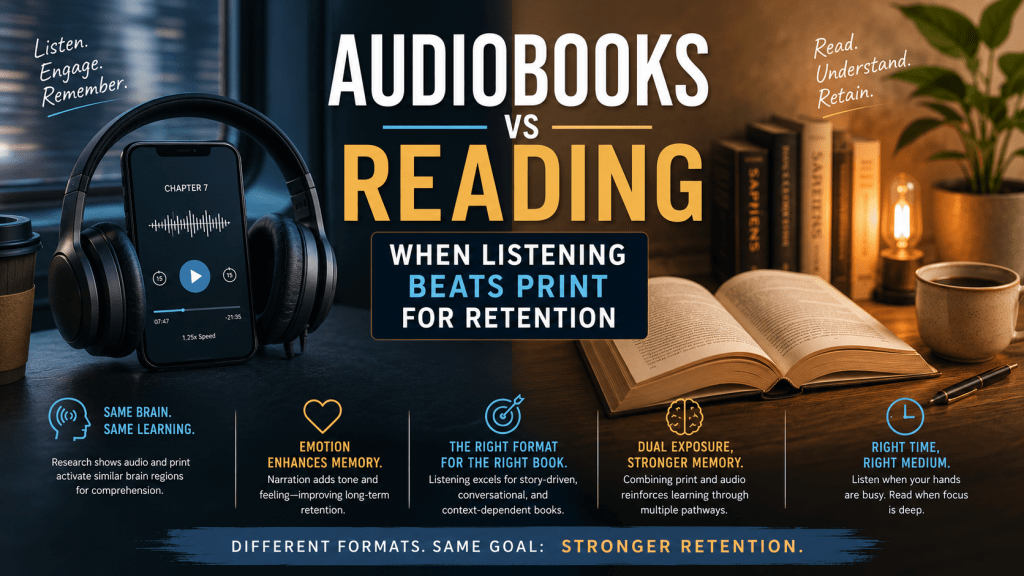
The audiobook vs. print debate is largely a false dichotomy. Your brain processes language, not pixels or sound waves. What determines retention is the depth of your engagement, the emotional resonance of the material, and the match between format and content — not the medium itself.
For narrative-driven books, re-reads, conversational non-fiction, and the books you’d otherwise skim, listening doesn’t just match print. It can genuinely beat it. For dense, technical, or heavily visual material, print remains the superior tool.
Stop feeling guilty about your audiobook habit. Start being strategic about it. The goal isn’t to read in the “right” format. The goal is to remember what matters and let it change how you think.
Your ears are just as capable as your eyes. Use both.
Related Reading
- Reading on Paper vs Screens: Why Analog Learning Still Wins
- How to Read for Retention: Why Reading Too Fast is a Mistake
- Why Book Summaries Fail: The Truth About Reading Retention
- The Reading Flywheel: How to Remember, Apply, and Learn More From Books
- The Reading Afterlife: What to Do After You Finish a Book to Remember and Apply It
- How to Turn What You Read Into Real Behavior Change (That Actually Sticks)
- Syntopical Reading: How to Master Any Subject with 5 Books
- How to Read Critically: Why Disagreeing With Books Makes You a Smarter Reader


Leave a Reply