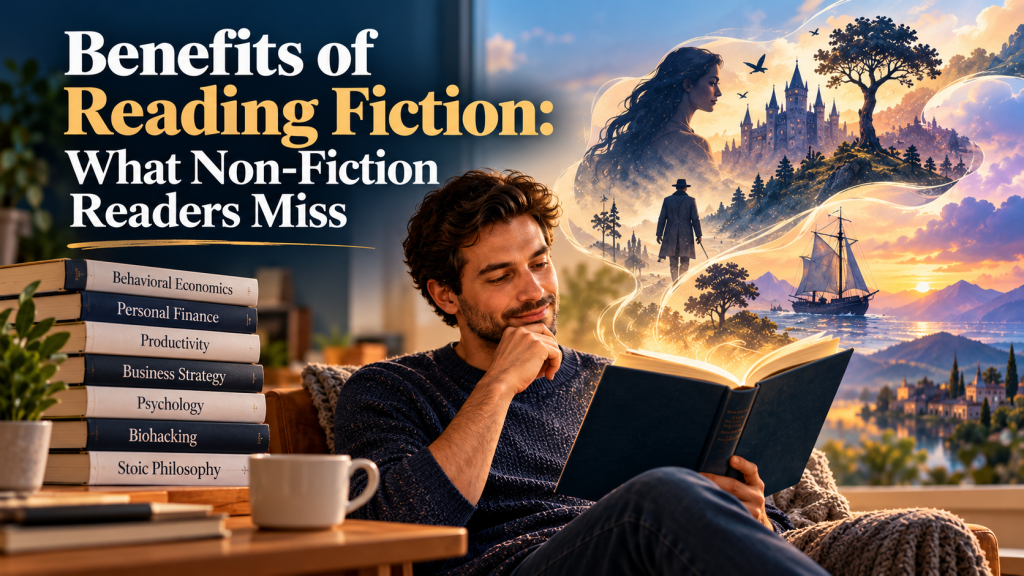
If you are an ambitious, analytically minded person, your bookshelf probably looks like an optimization manual.
There are volumes on behavioral economics, personal finance, operational systems, biohacking, and stoic philosophy. There are memoirs of industrial titans and military strategists. Every title was chosen with a clear, transactional purpose: to acquire actionable knowledge, extract competitive leverage, or solve a specific problem.
At some point in your twenties or thirties, you likely made a conscious decision to drop fiction. The internal rationale felt mature and pragmatic: Life is short, time is scarce, and I don’t have hours to waste on made-up stories when there is so much real-world knowledge to master.
This is what can be called the Efficiency Trap of Modern Reading.
When you treat reading exclusively as an information-extraction exercise, you run headfirst into a wall of diminishing returns. After your fiftieth business or productivity book, you begin to notice that most non-fiction books are simply 20-page essays padded with repetitive case studies to justify a spine and a $28 price tag. The frameworks start repeating. The insights grow incremental.
More importantly, by banishing fiction, you inadvertently starve your brain of the exact cognitive capacities that non-fiction cannot cultivate: deep empathy, tolerance for ambiguity, narrative intelligence, and lateral creativity.
Fiction is not an indulgence or an escape from reality. Done right, it is a high-fidelity flight simulator for the human condition. Here is what non-fiction readers miss when they dismiss fiction—and why returning to great stories might be the single most potent cognitive upgrade you make this decade.
1. The Theory of Mind: Fiction as an Empathy Engine
In cognitive psychology, Theory of Mind refers to the capacity to attribute mental states – beliefs, intents, desires, emotions, and knowledge – to oneself and others, understanding that others have beliefs and desires distinct from one’s own.
It is the foundational architecture of social intelligence. It governs your ability to negotiate a high-stakes contract, navigate a delicate marriage dispute, read the unstated anxieties of a colleague, or understand why a friend behaves self-destructively.
Non-fiction explains about people; fiction forces you to be people.
When you read a sociological study or a leadership manual on management, you are observing human behavior from thirty thousand feet. You receive clinical abstractions: “People resist change due to loss aversion.”
When you read Leo Tolstoy’s The Death of Ivan Ilyich, George Eliot’s Middlemarch, or Kazuo Ishiguro’s The Remains of the Day, you do not receive a summary. You are wired directly into the interior monologue of a human being rationalizing their compromises, hiding their terror, and navigating their vanity.
Non-Fiction: Describes human behavior from the outside.
Fiction: Simulates human consciousness from the inside.
In a landmark study published in Science by psychologists David Comer Kidd and Emanuele Castano, researchers demonstrated that reading literary fiction immediately enhances an individual’s Theory of Mind performance compared to reading popular fiction, serious non-fiction, or nothing at all.
Why literary fiction specifically? Because great fiction leaves gaps. It does not hand you tidy moral takeaways on a silver platter. It forces your neural circuitry to perform continuous predictive modeling about why a character said one thing while looking at the floor, or why their actions betray their declared convictions.
That mental modeling is the exact same muscle you use in real life to navigate complex human relationships. Non-fiction gives you the vocabulary of human dynamics; fiction builds the intuitive sensory apparatus.
2. Cognitive Closure vs. Tolerance for Ambiguity
Modern non-fiction trains you to seek clean, linear answers:
- 3 habits to master your morning.
- 5 mental models for better decision-making.
- The single framework that explains inflation.
This satisfies our innate Need for Cognitive Closure – the psychological desire for an answer on a given topic, any answer, compared to confusion and ambiguity.
The trouble is that the real world – markets, relationships, health crises, geopolitics – is inherently chaotic, non-linear, and saturated with incomplete information. The most catastrophic mistakes in business and life rarely stem from a lack of facts; they stem from applying rigid, oversimplified frameworks to complex, ambiguous realities.
Fiction is the ultimate antidote to dogmatic thinking because great stories are built on unresolved tensions and moral paradoxes.
Consider Fyodor Dostoevsky’s Crime and Punishment. A simplistic non-fiction framework would categorize Raskolnikov merely as a criminal acting on a flawed utilitarian philosophy. But Dostoevsky forces you to spend five hundred pages inside the claustrophobic, brilliant, feverish mind of a killer who is simultaneously grotesque and deeply sympathetic, generous and monstrous.
When you finish a masterwork of literature, you rarely walk away with a neat checklist. You walk away with a profound humility regarding how little you can truly judge another human being from surface actions alone.
Fiction builds cognitive flexibility. It trains you to hold two opposing ideas in your mind at the same time without losing your grip on reality – a quality F. Scott Fitzgerald famously called the mark of a first-rate intelligence.
3. Lateral Thinking and Metaphorical Reasoning
Non-fiction builds domain-specific knowledge in vertical silos: finance, software architecture, nutritional biochemistry, macroeconomics.
While vertical expertise is essential early in your career, breakthrough insights, innovative strategies, and creative leaps almost never come from within a single silo. They occur at the intersections. They are born from associative thinking – the ability to map structures, metaphors, and insights from one domain onto an entirely unrelated problem.
Fiction is a masterclass in associative thought.
When you read Gabriel García Márquez, Ursula K. Le Guin, or Jorge Luis Borges, your brain is constantly forced to decode metaphors, bridge thematic paradoxes, and visualize alternative systems of reality. You are exercising your brain’s pattern-matching machinery across non-standard datasets.
Vertical Knowledge (Non-Fiction):
Silo A: [Point 1] -> [Point 2] -> [Point 3]
Lateral Synthesis (Fiction + Interdisciplinary Thought):
Domain A (Mythology) <—> Domain B (Economics) <—> Domain C (Human Nature)
History’s most innovative thinkers rarely read exclusively within their technical domains:
- Albert Einstein credited his breakthroughs in physics not to mathematics alone, but to visual imagination and his reading of philosophy and literature, notably Dostoevsky and Cervantes.
- Charlie Munger, while a ferocious reader of biographies and history, consistently emphasized that psychological insight and narrative judgment were the bedrock of great investing, far outweighing spreadsheet fluency.
When you read complex fiction, you develop an ear for subtext, symbolism, and narrative arc. In business and investing, this translates into an ability to spot when a company’s corporate presentation is telling a compelling fairy tale that defies human nature, or when an entire market is acting out a classic Greek tragedy of hubris and blind panic.
4. Upgrading Your Internal Monologue and Cognitive Nutrition
Just as your physical health reflects what you eat, the clarity of your thought is constrained by the quality of the language you consume. This is Cognitive Nutrition.
The vast majority of modern business, self-help, and pop-science non-fiction is written in what can charitably be called “efficient airport prose”. The vocabulary is functional, the sentence structures are uniform, and the cadence is predictable. It is engineered for rapid scanning, not linguistic depth.
When you consume only this grade of prose for years on end, your own internal monologue begins to flatten. Your capacity to articulate nuanced emotional states, subtle observations, and complex conceptual arguments degrades into corporate platitudes and bullet points.
Great fiction, by contrast, exposes your brain to the pinnacle of human linguistic craft:
“He stepped down, trying not to look long at her, as if she were the sun, yet he saw her, like the sun, even without looking.”
— Leo Tolstoy, Anna Karenina
“There are darknesses in life and there are lights, and you are one of the lights, the light of all lights.”
— Bram Stoker, Dracula
“So we beat on, boats against the current, borne back ceaselessly into the past.”
— F. Scott Fitzgerald, The Great Gatsby
Exposing your mind to syntactically complex, rhythmically rich prose does something profound to your cognitive machinery:
- It expands your active vocabulary, giving you sharper tools to dissect your own internal experiences.
- It improves your working memory, as you track intricate sentence structures, character genealogies, and layered plot developments across hundreds of pages.
- It makes you a far better writer and communicator. You absorb rhythm, pacing, tension, and tone by osmosis, which immediately elevates your emails, essays, strategy memos, and spoken presentations.
5. Down-Regulating the Nervous System and Escaping the Productivity Engine
For knowledge workers, screen operators, and independence seekers, the boundary between “work” and “leisure” has largely dissolved.
When you sit down on the couch at 9 p.m. with a non-fiction book about portfolio rebalancing, longevity biomarkers, or systems architecture, your brain does not perceive that as rest. Your prefrontal cortex remains fully engaged in problem-solving mode. You are analyzing, evaluating, categorizing, and considering how to apply what you are reading to your life.
Your sympathetic nervous system stays quietly humming in the background.
Fiction operates on a completely different neurological pathway. When you enter a narrative, you experience what psychologists term narrative transportation – a state of intense immersion where your real-world anxieties, cognitive task lists, and ego defenses temporarily recede.
Reading Business Non-Fiction at Night:
Alertness High -> Analytical Critique Active -> Problem-Solving Mode -> Cortisol Maintained
Reading Immersive Fiction at Night:
Visual Cortex Engaged -> Self-Referential Ego Quieted -> Flow State Induced -> Nervous System Down-Regulated
A study by the University of Sussex demonstrated that reading silent fiction for just six minutes was more effective at reducing stress levels (lowering heart rate and muscle tension) than listening to music, drinking a cup of tea, or going for a walk.
Fiction provides a genuine off-ramp for the over-optimized mind. It satisfies the desire to engage with ideas and language without keeping the cognitive machinery of your day job spinning in neutral.
6. The Lindy Effect of Character: Understanding Human Nature That Never Changes
In non-fiction, information dates rapidly. A book on SEO from 2018 is useless today. A book on macroeconomics written before zero-interest-rate policy may miss crucial modern dynamics. You must constantly filter for freshness.
Fiction operates under the Lindy Effect: the idea that the future life expectancy of a non-perishable technology or idea is proportional to its current age.
A novel that has been read continuously for two hundred years has survived because it captures something fundamentally immutable about human nature. Human hardware has not changed for fifty thousand years. Our tools evolve, but our core drives – envy, ambition, love, fear, hubris, loyalty, self-deception – remain identical to what they were in ancient Athens, renaissance Florence, or Victorian London.
| If you want to understand… | Read this instead of a modern business book: |
|---|---|
| Hubris and organizational blind spots | Herman Melville’s Moby-Dick |
| Bureaucracy and modern institutional alienation | Franz Kafka’s The Trial |
| Social climbing and status dynamics | Stendhal’s The Red and the Black |
| Power politics and factional maneuvering | William Shakespeare’s Julius Caesar or Macbeth |
| The psychological cost of pure rationality | Mary Shelley’s Frankenstein |
Biographies tell you what a specific historical figure managed to do under specific historical conditions. Great fiction reveals what every human being is capable of doing under any condition. If you want a durable framework for predicting human behavior in markets, teams, and families, the classic literary canon offers vastly higher signal-to-noise than the business bestseller list.
How to Return to Fiction (A System for the Analytical Reader)
If you haven’t finished a novel in five or ten years, you cannot simply jump headfirst into James Joyce’s Ulysses or Marcel Proust’s In Search of Lost Time. Your attention span has likely been shaped by short-form digital media and modular non-fiction subheadings.
Here is a simple, practical playbook to rehabilitate your fiction habit:
1. Start with High-Density, Philosophical Novellas
Begin with short, tightly constructed books that respect your time and pack immense philosophical weight into under two hundred pages:
- Albert Camus — The Stranger (Absurdism, meaning, truth)
- John Steinbeck — Of Mice and Men or The Pearl (Human dignity, longing, tragic reality)
- Ted Chiang — Stories of Your Life and Others (Brilliant philosophical sci-fi exploring determinism, language, and memory)
- Ernest Hemingway — The Old Man and the Sea (Resilience, craft, solitary perseverance)
2. Strip Away the “Study Habits”
Put away the highlighter. Close your Notion note-taking database. Stop looking for “three key takeaways” to tweet about or catalog in your personal knowledge base.
Read fiction with your critical, analytical ego turned off. If an insight is profound enough, it will alter your perception organically; it does not need to be filed away into a spreadsheet to be valuable. Treat the reading experience as an immersive cognitive state, not an administrative task.
3. Adopt the 50/50 Rule
Do not abandon non-fiction entirely – simply implement an intellectual cross-training policy. For every non-fiction book you complete on finance, history, or health, your next book must be a work of fiction.
This prevents the intellectual calcification that occurs when you spend too long inside one genre, while keeping your reading diet balanced between vertical skill acquisition and lateral cognitive expansion.
Beyond the Utility Trap
There is a deeper, quieter reason to read fiction that has nothing to do with empathy scores, creative lateral thinking, or stress reduction metrics.
When you spend your entire life measuring every activity by its measurable utility – asking constantly, “How will this make me richer, faster, healthier, or more productive?” – you subtly transform yourself into a machine. You begin to treat your life as a project to be engineered rather than an experience to be inhabited.
Financial independence, physical health, and professional mastery are foundational goals, but they are ultimately enablers. They clear the brush so that you have the time, space, and energy to engage with what it actually means to be alive.
Fiction is one of the oldest and most profound technologies humanity ever invented to answer that question. It invites you to step outside the narrow confines of your own skull, live a thousand other lives across a thousand different centuries, and return to your own reality with clearer eyes, deeper patience, and a renewed sense of wonder.
Put down the productivity manual for a week. Pick up a great novel. You won’t fall behind – you’ll finally catch up.
Related Reading
If you enjoyed this exploration of reading, cognition, and lifelong learning, explore these related essays from the archive:
- How Fiction Books Can Inspire Personal Growth and Reflection
- Why Read Biographies for Personal Growth: The Decision-Making Lessons Dead People Teach Best
- Why Old Books are Better Than Bestsellers: The Lindy Effect
- Intellectual Cross-Training: The Benefits of Reading Outside Your Field
- Cognitive Nutrition: Why Information Quality Matters More Than Quantity
- Why Smart Readers Still Don’t Change: How to Apply What You Read
- How to Read for Retention: Why Reading Too Fast is a Mistake
- Syntopical Reading: How to Master Any Subject with 5 Books


Leave a comment