Most non-fiction tells you what to think. Biographies show you what thinking looks like under pressure.
When you read a self-help book, you get a framework. Clean, tidy, and usually stripped of the messy context that made the framework necessary in the first place. The author has already done the editing. They’ve removed the three failed businesses, the divorce, the decade of confusion, and the lucky break they don’t want to admit was luck. What remains is a five-step system that sounds inevitable but was actually accidental.
Biographies don’t let you skip the mess. And that’s exactly why they’re the most underrated genre for personal growth.
A biography gives you something no productivity book can: a complete life, compressed into a few hundred pages, with all the contradictions, reversals, and quiet pivots intact. You watch a real human being make decisions with incomplete information, under real constraints, with real consequences. And because the person is usually dead, you already know how the story ends — which means you can study the decisions that actually mattered, not the ones that merely sounded important at the time.
If you’re building a life around financial independence, long-term health, or meaningful travel, the best mentors you’ll ever find are people who’ve been dead for decades. Here’s why.
Biographies Beat Self-Help Because Context Is the Curriculum
The biggest problem with prescriptive advice is survivorship bias dressed up as a system.
Someone writes a book about how they built a $10 million company by waking up at 4 a.m., journaling, and saying no to everything. You read it, adopt the routine, and wonder why your results look nothing like theirs. What the book didn’t mention is that they started during the biggest bull market in a generation, had a co-founder who handled all the operations, and got acquired because a competitor needed their patent — not their morning routine.
Biographies force context back into the picture. When you read about Benjamin Franklin, you don’t just learn that he was disciplined. You learn that his discipline emerged from years of financial insecurity, a strained relationship with his brother, and a city — Philadelphia — that was small enough for reputation to function as currency. His famous virtue-tracking system wasn’t a productivity hack. It was a survival strategy for a man who couldn’t afford to be disliked.
That distinction matters enormously for your own decision-making. When you understand the constraints someone operated under, you stop copying their habits and start understanding their reasoning. You stop asking “What did they do?” and start asking “Why did they do that, given what they knew at the time?”
That shift — from imitation to interpretation — is where real learning happens.
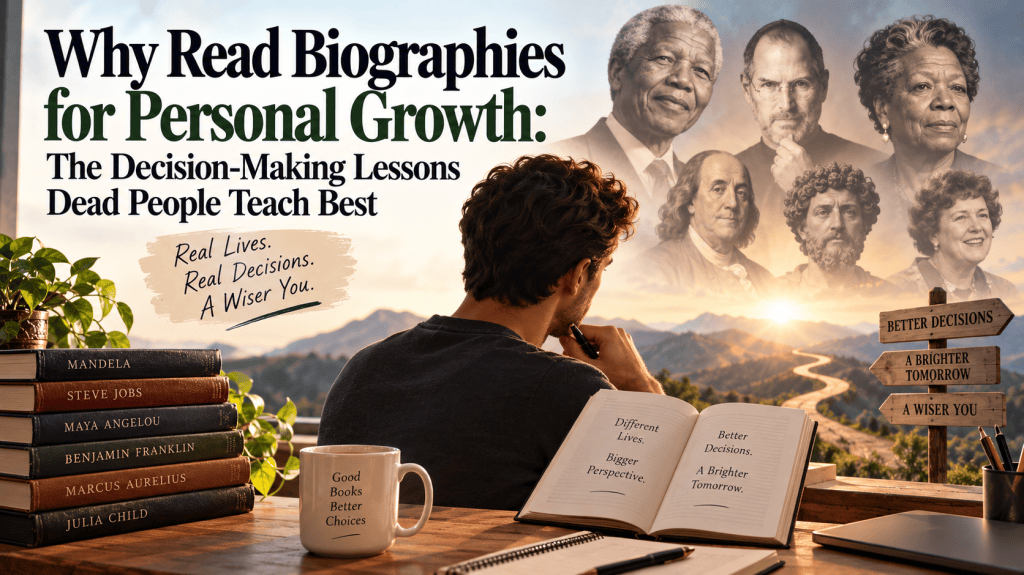
The Compression of a Lifetime Into an Afternoon
Think about how long it takes to learn a lesson the hard way. You make a bad financial decision at 28. You spend the next five years recovering from it. At 33, you finally understand what you should have done at 28. That’s a five-year feedback loop for a single insight.
Now imagine getting that same insight in a chapter you read on a Tuesday evening.
A good biography compresses 70 or 80 years of trial, error, recovery, and compounding into roughly 300 to 500 pages. You watch someone navigate their twenties with the benefit of knowing what their sixties looked like. You see which risks paid off and which ones quietly destroyed a decade. You watch them make the exact same mistake you’re about to make — and you get to see the consequences without paying the cost.
This is the closest thing to a time machine that exists.
When you read about Marcus Aurelius ruling Rome during a plague, a war, and a succession crisis, you’re not reading history. You’re watching a man practice emotional regulation under conditions that make your bad quarter at work look trivial. When you read about Maya Angelou navigating poverty, trauma, and reinvention across multiple careers, you’re watching someone rebuild identity from scratch — repeatedly.
The return on investment is absurd. A $15 book and six hours of reading can give you the distilled wisdom of a lifetime. No course, podcast, or coaching program comes close to that ratio.
Decision-Making Patterns You Can Actually Steal
Reading one biography gives you a story. Reading ten gives you patterns. And patterns are where the real decision-making leverage lives.
After reading dozens of biographies across different fields, eras, and temperaments, a few recurring patterns emerge that are directly applicable to modern life:
The strategic pivot. Most people who accomplished remarkable things didn’t follow a straight line. They zigzagged. Darwin studied theology before biology. Julia Child didn’t start cooking until she was 36. Colonel Sanders franchised KFC at 62. The pattern isn’t “find your passion early”. It’s “stay curious long enough for the right opportunity to recognize you”. If you’re in the middle of a career pivot or rethinking your path to financial independence, this pattern is deeply reassuring.
The power of deliberate constraints. The most productive people in history didn’t have more time than you. They had fewer options and treated that as an advantage. Michelangelo didn’t want to paint the Sistine Chapel ceiling — he considered himself a sculptor. The constraint forced him into a medium he would never have chosen, and it produced his most famous work. When you’re tempted to keep your options open, remember that optionality is valuable only until it becomes paralysis.
The long patience. Almost every biography of a successful investor, scientist, or creator includes a stretch of years — sometimes decades — where nothing visible was happening. Darwin sat on his theory of evolution for over 20 years. Buffett’s wealth is almost entirely a product of compounding after age 50. The lesson isn’t glamorous, but it’s the most important one for anyone pursuing FIRE (Financial Independence, Retire Early): the boring middle is where the real work happens, and impatience is the most expensive emotion you can afford.
The selective no. The people who shaped history said no to almost everything. They were ruthless about protecting their time, energy, and attention — not because they were lazy, but because they understood that every yes to a minor opportunity was a no to the major one. If you’re struggling with overcommitment, overtravel, or overconsumption of information, this pattern is your permission structure to cut aggressively.
Learning From the Negative Space: Why Failures Teach More Than Wins
Most people read biographies for inspiration. They want the highlight reel — the breakthrough, the triumph, the moment everything clicked. That’s fine for motivation, but it’s terrible for learning.
The most valuable parts of any biography are the failures, and specifically the failures that the subject didn’t see coming.
When you read about a brilliant strategist who made a catastrophic bet, you’re watching intelligence fail in real time. And that’s far more instructive than watching intelligence succeed, because success is often contaminated by luck, timing, and circumstances you can’t replicate. Failure, by contrast, tends to be more honest. It reveals the actual weaknesses in someone’s thinking — the blind spots, the ego traps, the assumptions that seemed reasonable at the time but were quietly wrong.
Read about Napoleon’s invasion of Russia. Read about Kodak inventing the digital camera and then burying it. Read about brilliant investors who blew up their portfolios by refusing to adapt to a regime change in the market. These aren’t cautionary tales. They’re diagnostic tools. They help you identify the same patterns in your own thinking before the consequences arrive.
The best biographies don’t flinch from the ugly chapters. Seek those out. The sanitized ones will make you feel good. The honest ones will make you better.
How to Read Biographies for Maximum Retention and Application
Reading a biography passively is like watching someone else exercise. You observe the movement but don’t build the muscle. If you want biographies to actually change how you make decisions, you need a system.
Read with a question. Before you start, pick one decision-making question you’re currently wrestling with. It could be “When should I take a big financial risk?” or “How do I know when to quit something?” or “How do I rebuild after a setback?” Hold that question in the back of your mind as you read. You’ll be amazed at how your brain starts flagging relevant passages automatically.
Annotate the decisions, not the facts. Most people highlight dates, achievements, and quotes. Instead, highlight the moments where the subject faced a fork in the road. What did they know at the time? What were they afraid of? What did they choose, and why? These decision points are the actual curriculum.
Compare across lives. One biography gives you a data point. Three biographies give you a pattern. After you finish a biography, spend ten minutes comparing the subject’s approach to someone you’ve already read about. How did their risk tolerance differ? How did they handle failure? How did they think about time? This cross-pollination is where reading becomes a superpower rather than a hobby.
Write a one-paragraph takeaway. After finishing, write a single paragraph answering this question: “What would I do differently this week based on what I just read?” If you can’t answer it, the book informed you but didn’t change you. That’s fine — not every book needs to. But the ones that do are the ones worth rereading.
The Dead Have Already Paid the Tuition
You don’t need to make every mistake yourself. The people who came before you already made most of them, and the best of them left detailed records of what went wrong, what went right, and what they wish they’d known.
Biographies are the highest-leverage reading you can do because they teach judgment, not information. In a world drowning in data, frameworks, and hot takes, judgment is the scarce resource. And judgment is built by watching other humans navigate complexity — not by reading someone’s five-step summary of how they think they did it.
So the next time you’re looking for your next book, skip the latest bestseller and pick up the life story of someone who’s been dead long enough for the hype to fade. The Lindy Effect applies to people as much as it applies to books: the ones still worth reading about after a century are the ones who solved the problems you’re currently pretending you’ll figure out later.
Dead people don’t need your attention. But they’ve earned it. And the lessons they left behind are still compounding.
Related Reading
- Why Old Books are Better Than Bestsellers: The Lindy Effect
- Syntopical Reading: How to Master Any Subject with 5 Books
- How to Read Critically: Why Disagreeing With Books Makes You a Smarter Reader
- The Reading Afterlife: What to Do After You Finish a Book to Remember and Apply It
- How to Turn What You Read Into Real Behavior Change (That Actually Sticks)
- Why Book Summaries Fail: The Truth About Reading Retention
- Intellectual Cross-Training: The Benefits of Reading Outside Your Field
- How to Read for Retention: Why Reading Too Fast is a Mistake
 VD
VD 
Leave a comment