English speakers live inside the most comfortable intellectual bubble in human history. Roughly 1.5 billion people speak English worldwide, which means publishers, algorithms, and bestseller lists are optimized to feed you an endless stream of English-language content. You never have to leave. And that’s exactly the problem.
Here’s a number that should bother you: only about 3–5% of books published in the United States each year are translations. In the UK, it’s closer to 3.5%. Compare that to Germany, where roughly 12–14% of published books are translated, or Turkey, where the number climbs above 40%.
The English-speaking world imports almost nothing and exports almost everything. Which means your reading list — no matter how diverse, how curated, how intellectually ambitious — is drawing from a fraction of what’s available.
This post isn’t a guilt trip about reading more “world literature”. It’s a practical argument that reading translated books is one of the most underrated cognitive upgrades you can give yourself. Not because it makes you more cultured (though it does), but because it literally changes how you think.
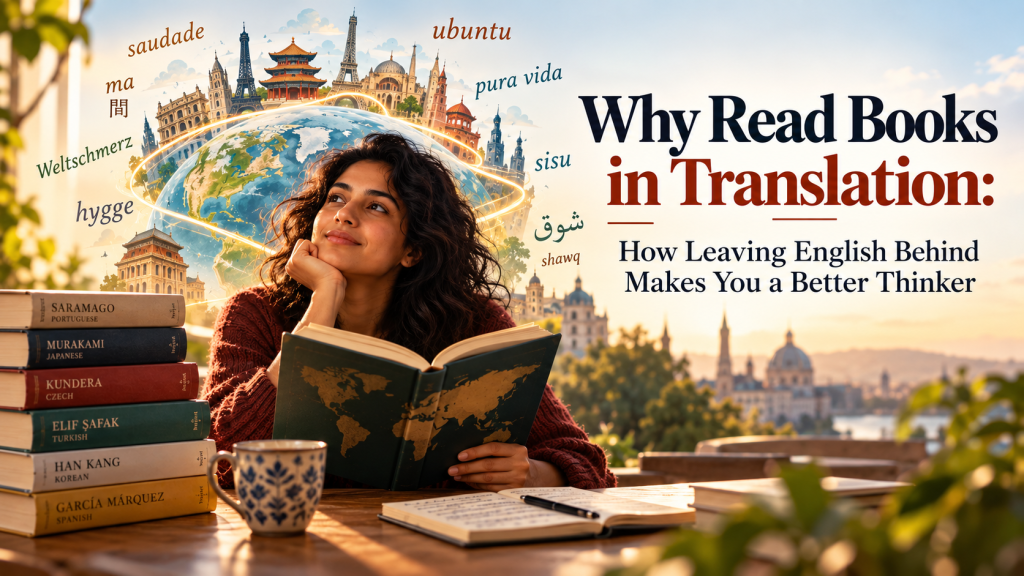
The Comfort Problem: Why English-Only Reading Creates Blind Spots
Every language encodes a worldview. This isn’t poetic metaphor — it’s linguistics. The Sapir-Whorf hypothesis, in its moderate and widely accepted form, suggests that the language you think in shapes the categories you use to organize reality.
English, for instance, is obsessed with agency and individualism. Sentences tend to follow a subject-verb-object structure that foregrounds the actor: “I made a decision”. Japanese, by contrast, often omits the subject entirely when context makes it obvious, subtly decentering the individual. Spanish uses two verbs for “to be” — ser (essential identity) and estar (temporary state) — which forces speakers to constantly distinguish between what something is and what something happens to be right now.
When you read exclusively in English, you absorb these structural assumptions without noticing them. You start to believe that the way English carves up reality is the default way reality is carved up. Reading in translation disrupts that assumption. Even through the filter of a translator’s choices, you encounter sentence structures, metaphors, and conceptual frameworks that don’t map neatly onto English thinking.
That disruption is the point.
Cognitive Friction is a Feature, not a Bug
One of the most common complaints about translated books is that they “feel slightly off”. The dialogue sounds stilted. The pacing is unusual. A metaphor lands strangely. Readers often interpret this as a flaw — a sign of a bad translation or a book that wasn’t meant for them.
I’d argue the opposite. That slight friction is a cognitive signal that you’re encountering a different operating system for thought.
When you read a novel translated from Korean, like Han Kang’s The Vegetarian, you’ll notice that the narrative doesn’t follow the three-act structure that English-language fiction treats as gospel. The tension doesn’t escalate in the way you expect. Characters don’t “arc” in the way your brain has been trained to anticipate. Your reading brain has to work harder to construct meaning, and that extra effort activates deeper processing.
Research on desirable difficulties in learning — a concept popularized by cognitive psychologist Robert Bjork — shows that information acquired through slightly harder processing is retained longer and applied more flexibly. Translated books are a real-world application of this principle. The mild disorientation you feel is your brain building new neural pathways instead of coasting on old ones.
If every book you read feels effortless and familiar, you’re not reading widely. You’re reading comfortably. And comfort is the enemy of cognitive growth.
Ideas that don’t exist in English
Some concepts simply don’t have English equivalents, and reading translated books is the only way to encounter them in their native habitat.
Consider the Portuguese word saudade — a deep, melancholic longing for something or someone that may never return. English approximates it with “nostalgia” or “yearning”, but neither word carries the same weight of permanence and beauty. When you read a novel by José Saramago in translation, saudade saturates the emotional landscape even when the word itself never appears. You absorb the concept through context, through the rhythm of the prose, through the way characters relate to loss.
Or take the Japanese concept of ma (間) — the meaningful emptiness between things. It’s the silence between notes in music, the pause in a conversation that carries more meaning than the words. English has no single word for this. But when you read Haruki Murakami or Yoko Ogawa, ma structures the entire narrative. The gaps matter as much as the events.
These aren’t vocabulary trivia. They’re conceptual tools. Once you internalize saudade or ma or the German Weltschmerz or the Russian toska, you gain new lenses for interpreting your own experience. You start noticing emotional textures that English never gave you words for — which means you probably never gave them attention.
Reading in translation expands your conceptual vocabulary in ways that reading in English alone simply cannot.
Different Cultures Build Stories Differently
English-language fiction, particularly American fiction, is dominated by a specific narrative architecture: the protagonist faces a conflict, undergoes a transformation, and reaches a resolution. It’s the hero’s journey, the three-act structure, the character arc. It’s so pervasive that most readers mistake it for the way stories work.
It isn’t.
Latin American magical realism — think Gabriel García Márquez or Isabel Allende — treats time as cyclical rather than linear. Events loop, repeat, and fold into each other. The narrative doesn’t “build” toward a climax so much as it spirals.
Arabic literature, particularly the tradition rooted in One Thousand and One Nights, favors nested storytelling — stories within stories within stories — where the frame narrative matters as much as the tale inside it. Naguib Mahfouz’s Cairo Trilogy uses this layered structure to mirror the way memory and history actually work.
Chinese literary fiction often prioritizes atmosphere and social observation over individual psychology. The “main character” in a novel by Yu Hua or Mo Yan may be less a person than a community, a historical moment, or a landscape.
When you read these structures in translation, you’re not just consuming a story. You’re learning that your default narrative expectations are culturally specific, not universal. That realization transfers directly to how you interpret real life — the stories you tell yourself about your career, your relationships, your identity. If the only story structure you know is the hero’s journey, you’ll force every experience into that template whether it fits or not.
The Empathy Expansion
There’s a well-documented link between reading literary fiction and improved theory of mind — the ability to understand that other people have beliefs, desires, and perspectives different from your own. But reading translated literary fiction takes this a step further.
When you read a novel set in Lagos, translated from Yoruba-inflected English, or a novella set in rural Iceland, translated from a language spoken by 370,000 people, you’re not just stepping into another person’s shoes. You’re stepping into another culture’s shoes. The social norms, family dynamics, power structures, and emotional vocabularies are fundamentally different from what you navigate daily.
This kind of perspective-taking is harder than reading about a character who looks like you, lives like you, and thinks like you but happens to have a different job. And harder perspective-taking builds stronger cognitive empathy.
In a world that increasingly rewards the ability to think across cultural boundaries — whether you’re negotiating a business deal, managing a remote team, or simply navigating a diverse city — this is a practical skill, not a luxury.
A practical framework for getting started
If you’ve never deliberately read a translated book, here’s a simple system to begin:
1. Start with short fiction. Novellas and short story collections are lower-commitment entry points. Try Borges (Spanish), Chekhov (Russian), or Clarice Lispector (Portuguese).
2. Follow the Nobel Prize list. The Nobel Prize in Literature disproportionately rewards non-English writers. The last decade alone includes Abdulrazak Gurnah (Swahili/English), Annie Ernaux (French), Olga Tokarczuk (Polish), and Han Kang (Korean).
3. Read the translator’s note. Good translations include one. It will tell you what choices the translator made and what was inevitably lost — which itself is a fascinating lesson in how language works.
4. Don’t chase fluency. Chase friction. The goal isn’t to become an expert in world literature. The goal is to encounter ideas and structures that challenge your defaults. If a book feels slightly strange, you’re doing it right.
5. Mix translations into your existing reading diet. You don’t need to abandon English-language books. Aim for one translated book for every four or five English ones. That 20% ratio is enough to consistently disrupt your patterns without overwhelming your reading habit.
The Bottom Line
Reading in translation isn’t about being well-read in the performative sense. It’s about cognitive diversity. Every language is a different solution to the problem of describing reality, and every translated book is a window into a solution you didn’t know existed.
The English-speaking world has extraordinary access to information but remarkably narrow access to perspective. Translated books are the cheapest, most accessible way to widen that aperture. You don’t need to learn a new language. You don’t need to travel. You just need to pick up a book that was originally written in a language you don’t speak and let the slight strangeness do its work.
Your thinking will be sharper, your empathy deeper, and your assumptions fewer. And that’s a return on investment that no English-only reading list can match.
Related Reading
If you enjoyed this post, you might also like:
- Benefits of Reading Fiction: What Non-Fiction Readers Miss
- Intellectual Cross-Training: The Benefits of Reading Outside Your Field
- Reading Across Disciplines: How Interdisciplinary Learning Fuels Creative Thinking
- How to Read Critically: Why Disagreeing With Books Makes You a Smarter Reader
- Why Old Books are Better Than Bestsellers: The Lindy Effect
- Syntopical Reading: How to Master Any Subject with 5 Books
- How to Improve Critical Thinking: The Thinking Gym Approach
- How Fiction Books Can Inspire Personal Growth and Reflection
☕ Enjoyed This Post?
If this article gave you a new perspective on your reading life, consider supporting my work. I write in-depth posts on financial independence, longevity, books, and travel — all from personal experience and deep research.
It takes 30 seconds and helps me keep publishing free, high-quality content like this. Thank you for reading! 🙏


Leave a Reply